

How To Align Software Architecture With Business Growth Objectives
-

- Name
- Keenfunnel
- GitHub
- @GitHub
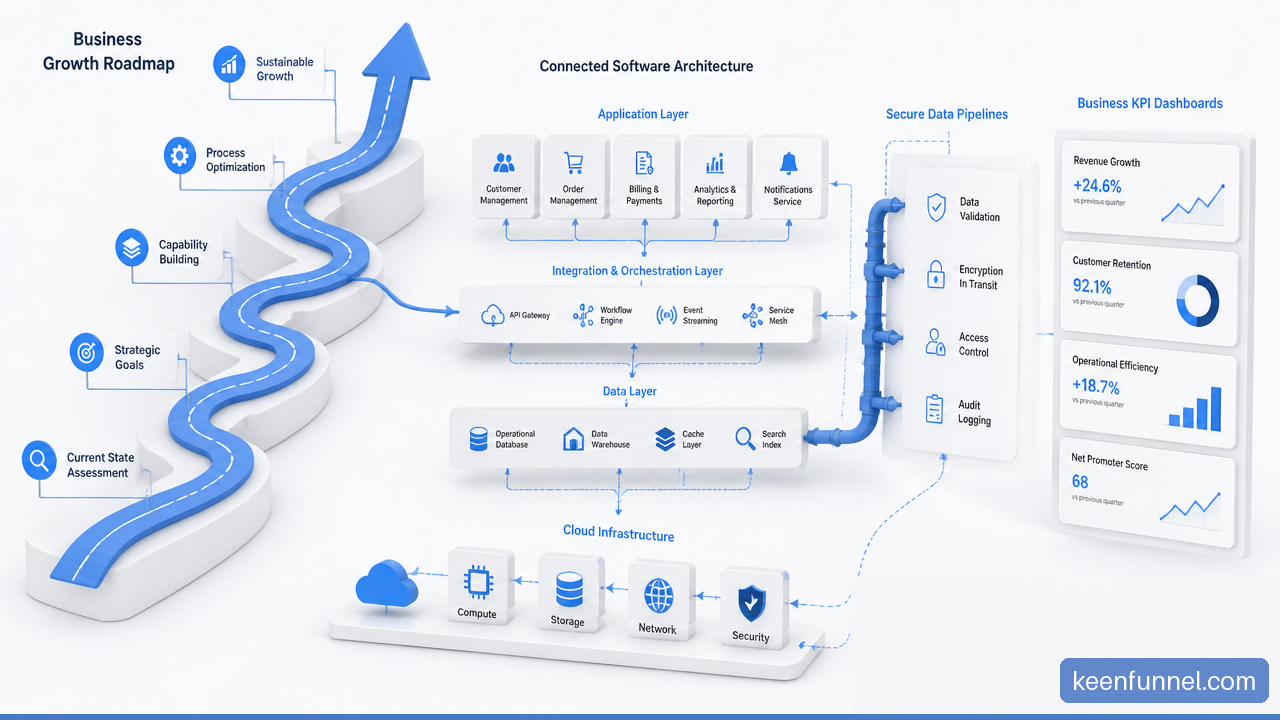
How to align software architecture with business growth objectives starts with a simple shift: treat architecture as a business operating decision, not an engineering preference. I recommend beginning with the growth result the company needs, then tracing backward to the capabilities, quality attributes, data flows, and technical tradeoffs required to deliver it.
A system built only for current demand may work well today yet become a constraint when sales volume rises, a new market requires compliance controls, or customers expect faster service. The aim is not to predict every future need. It is to create enough structure, visibility, and flexibility to respond without rebuilding the business around its software.
Table of Contents
• Trace Growth Goals To Architecture Decisions
• Turn Business Capabilities Into Measurable Guardrails
• Choose Architecture Patterns Based On Real Constraints
• Build A Roadmap And Governance Model
Trace Growth Goals To Architecture Decisions
Software architecture is the high level structure that determines how applications, data, integrations, infrastructure, and teams work together. It affects what changes are easy, what changes are risky, how fast teams can release, and how reliably customers can use the product.
The useful starting point is business strategy. Carnegie Mellon SEI describes software architecture as a bridge between business goals and the realized system. That framing prevents a common failure: selecting a fashionable technical pattern first and then trying to invent a business reason for it.
Identify The Actual Growth Bottleneck
“Growth” is too broad to guide architecture. A company can be growing through customer acquisition, stronger activation, retention, monetization, or account expansion. Each bottleneck creates different architecture priorities.
Growth Objective | Business Constraint | Likely Architecture Focus | Useful Business Signal |
|---|---|---|---|
Acquisition | More visitors and leads enter the funnel | Traffic handling, integrations, attribution data | Lead response time, conversion rate |
Activation | New users do not reach value quickly | Onboarding workflows, product events, latency | Time to first value, completion rate |
Retention | Customers leave after initial use | Reliability, support data, feature feedback loops | Churn rate, repeat usage |
Monetization | Billing or purchasing creates friction | Transaction integrity, pricing services, audit trails | Payment success rate, revenue per customer |
Expansion | Larger customers need more control | Permissions, tenant isolation, APIs, reporting | Expansion revenue, enterprise win rate |
Consider a B2B platform whose main problem is slow lead follow up. Splitting the product into many independent services may not improve that outcome. Better results may come from reliable CRM integration, event driven routing, data validation, and clear ownership of lead status. The architecture investment should match the constraint.
Build A Traceability Chain
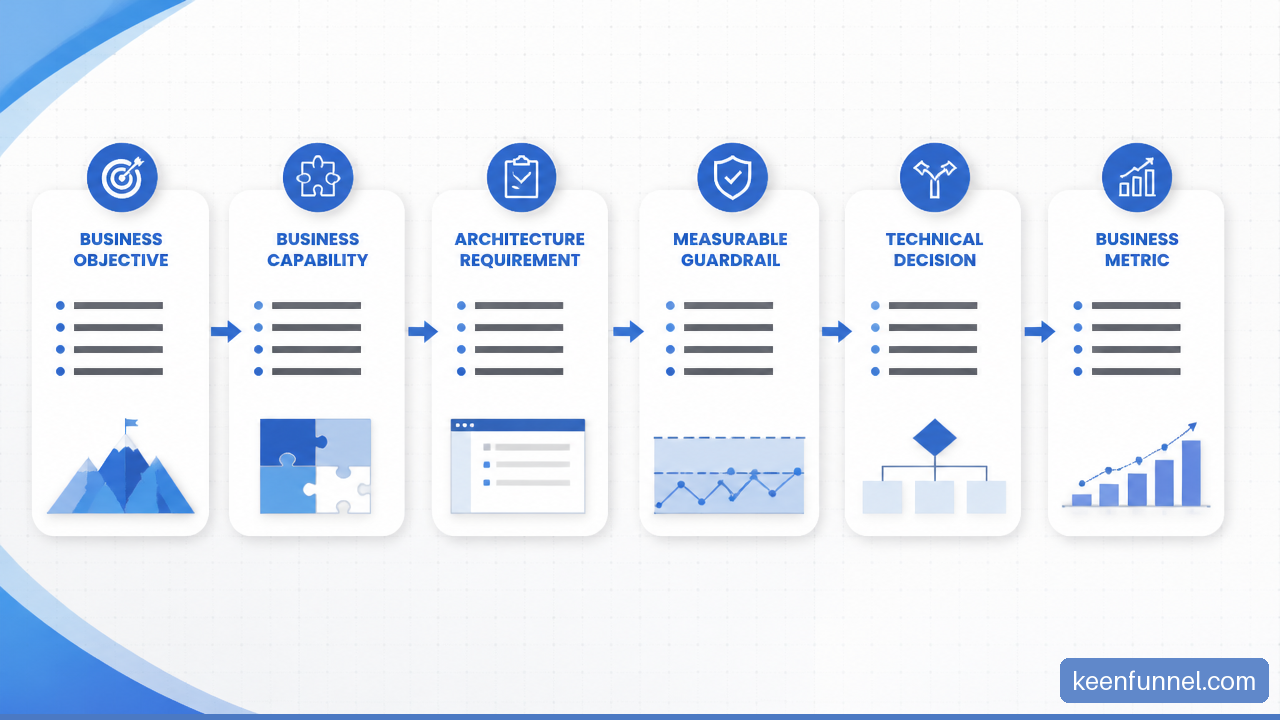
I recommend documenting a short traceability chain for every major growth objective:
Business objective: State the commercial or operational outcome in plain language.
Business capability: Define what the organization must reliably do to achieve it.
Architecturally significant requirement: Identify the requirement that changes system structure or technical tradeoffs.
Guardrail: Set a measurable threshold that defines acceptable performance, risk, or cost.
Architecture decision: Choose the design, platform, integration, or operating practice that supports the guardrail.
Evidence: Define the business and technical measures that will show whether the decision worked.
For example, an objective to enter a regulated market may require a capability to manage consent and customer records by region. That may create requirements for access control, audit logging, data retention, and regional data handling. The resulting architecture decision could include centralized identity, explicit data classification, and documented interfaces between systems.
Carnegie Mellon SEI explains that business goals drive architecturally significant requirements and quality attributes. In practical terms, a promise such as “customers can complete orders at any time” becomes availability, recovery, and transaction consistency requirements before it becomes a diagram.
Make Tradeoffs Visible To Stakeholders
No architecture maximizes speed, resilience, flexibility, security, and low cost at the same time. Leaders need to see the tradeoff, not just the recommendation.
A decision record can be brief, but it should name the objective, options, expected benefits, risks, owner, and review date. This creates a durable link between a technical choice and the business reason behind it. It also keeps a temporary shortcut from quietly becoming permanent architecture.
Architecture alignment is not agreement on a technology stack. It is agreement on which business outcomes deserve protection when tradeoffs become necessary.
Turn Business Capabilities Into Measurable Guardrails
A capability map shows what the business must be able to do, independent of the tools currently used. It is especially useful when a company has grown through acquisitions, spreadsheets, disconnected SaaS tools, or multiple product teams.
Define Quality Attributes In Business Terms
Quality attributes include performance, availability, security, modifiability, recoverability, and cost efficiency. These can sound technical until they are tied to a customer promise or financial exposure.
Avoid vague requirements such as “the system should be fast” or “the platform should scale.” Instead, write testable scenarios.
Business Need | Weak Requirement | Stronger Guardrail | Architecture Implication |
|---|---|---|---|
Faster customer response | Improve performance | New requests receive a response within the agreed service window under expected peak load | Queueing, workflow ownership, monitoring |
Dependable ordering | High availability | Checkout remains available during planned maintenance and common component failures | Redundancy, graceful degradation, recovery testing |
Reliable analytics | Better reporting | Revenue data is refreshed at an agreed interval with visible lineage | Data contracts, event capture, validation |
Controlled operating cost | Lower cloud spend | Cost per transaction stays within the planned range as volume grows | Capacity design, usage monitoring, efficient processing |
Regulated expansion | Meet compliance needs | Sensitive records have controlled access and traceable changes | Identity controls, audit logs, retention rules |
The exact threshold depends on the business model. A finance workflow and an internal employee portal should not receive the same uptime or recovery target. Fair warning: copying a threshold from a larger company can waste budget or leave a critical customer journey under protected.
Treat Data As Part Of The Product Architecture
Growth increasingly depends on trustworthy data. Marketing needs attribution, sales needs account context, operations needs workflow visibility, and product teams may need usage signals. If these records are duplicated or defined differently across systems, reports become a debate rather than a decision tool.
A practical data architecture establishes:
• Shared definitions for key terms such as lead, qualified opportunity, active customer, churn, and recognized revenue.
• Data contracts that state what each system sends, when it sends it, and who owns data quality.
• Lineage so teams can trace a dashboard metric back to source records and transformations.
• Freshness expectations that match the decision being made, whether near real time operations or weekly planning.
• Access rules that protect sensitive data without blocking legitimate work.
For AI initiatives, this foundation matters even more. An AI assistant connected to inconsistent CRM records, undocumented knowledge, or incomplete permissions can automate confusion at scale. Start with a bounded use case, approved data sources, human review points, and monitoring for errors. Add model serving and retrieval components only when the underlying data and operating controls are ready.
Pair System Metrics With Business Metrics
Technical metrics alone can create false confidence. A service may have excellent uptime while customers still abandon onboarding because data syncs arrive too late or a handoff fails.
Use paired measures. For a checkout service, track transaction latency alongside payment completion. For lead routing, track integration failures alongside first response time and meeting conversion. For analytics, track pipeline freshness alongside forecast accuracy or decision cycle time.
This is how observability becomes a growth tool rather than a purely engineering activity. Logs, metrics, and traces explain why a business KPI changed. The KPI explains whether the technical work was worth doing.
Choose Architecture Patterns Based On Real Constraints
There is no universally best architecture for a growing product. A well structured monolith can be the fastest and safest choice for a focused team. Microservices can improve independent deployment and scaling, but they also add operational complexity. Cloud native services can reduce infrastructure work, though they can introduce vendor dependencies and cost variability.
XB Software argues that architecture should reflect strategic priorities and a three to five year growth trajectory. That is a useful planning horizon because it forces teams to consider future users, transactions, integrations, and operating needs without pretending to forecast a decade precisely.
When A Modular Monolith Is The Better Choice
Choose a modular monolith when the product domain is still changing quickly, the engineering team is relatively small, and most features need coordinated releases. The key word is modular. Clear internal boundaries, well defined domain ownership, and disciplined interfaces make later extraction possible if it becomes necessary.
Avoid a monolith when one component’s workload, release risk, compliance boundary, or team ownership is repeatedly disrupting unrelated parts of the product. For example, a computationally heavy reporting process that slows customer transactions may justify separation earlier than the rest of the application.
When Microservices Earn Their Cost
Microservices are appropriate when there is evidence of independent business domains, distinct scaling patterns, separate release schedules, and sufficient DevOps maturity. They should solve a known coordination or reliability problem.
Before adopting them, test the scenario:
Which capability needs independent change or scaling?
What customer or revenue risk exists if it stays coupled?
Can the team operate distributed logging, service ownership, API versioning, and incident response?
What new failure modes will network calls, asynchronous events, and data consistency introduce?
Would a modular boundary inside the current application solve the problem first?
Do not use microservices merely because traffic is increasing. A single application can scale considerably when its database, caching, background jobs, and deployment process are designed well. The deciding factor is usually complexity of change, not raw user count alone.
Use Scenario Based Tradeoff Analysis
A sound decision compares options against a realistic event. For instance: “A major customer requests a custom approval flow while the company is launching a new pricing model in 90 days.”
A tightly coupled system may deliver both changes quickly at first, but repeated customization can increase release risk. A fully distributed architecture may isolate the changes, yet coordination overhead could make a small team slower. The right answer depends on the frequency, value, and risk of such scenarios.
This approach prevents blanket modernization. It also makes a case for selective investment: improve the parts of the system that block growth, while leaving stable and low risk components alone.
Build A Roadmap And Governance Model
A target architecture is valuable only when it guides sequencing. It should describe the desired future state for business capabilities, applications, data, integrations, security, infrastructure, and operating practices. It should not be a decorative diagram of technologies.
Golden IT notes that productive architecture roadmaps begin with business priorities, including revenue growth, customer experience, operational efficiency, risk reduction, regulatory readiness, and faster delivery. That order matters: the roadmap should explain what business problem each phase addresses.
Prioritize Modernization As A Portfolio
Do not rank systems only by age or developer frustration. Score each candidate against business impact and architectural risk.
Priority Factor | Question To Ask | High Priority Signal |
|---|---|---|
Revenue impact | Does this system affect acquisition, conversion, billing, or expansion? | It blocks a measurable commercial objective |
Customer impact | Does failure or delay harm a core customer journey? | It drives support volume, abandonment, or churn |
Risk exposure | Does it create security, privacy, continuity, or compliance exposure? | It threatens market entry or contractual commitments |
Change friction | How difficult is it to release improvements safely? | Teams repeatedly delay valuable work |
Dependency centrality | How many workflows depend on it? | One failure disrupts multiple capabilities |
A useful sequencing model often has three workstreams: growth enablers, risk reduction, and debt retirement. This avoids the false choice between feature delivery and technical health.
Reserve Capacity For Architecture Debt
Technical debt should be tracked as a growth constraint, not a moral failure. Some debt is a rational shortcut when speed matters. It becomes dangerous when it repeatedly raises the cost, risk, or lead time of business change.
Reserve explicit delivery capacity for debt remediation. The amount varies by product stability and risk, but the principle is consistent: if debt work has no owner, budget, or roadmap slot, it will lose every planning cycle until a failure forces an expensive response.
A recovery plan should focus on the debt that blocks an upcoming objective. If a company plans self service onboarding, prioritize identity, provisioning, and workflow reliability before rewriting a low traffic internal reporting module.
Create Shared Governance Without Slowing Delivery
Governance should make decisions faster by setting boundaries in advance. It is not a committee that approves every library or minor implementation detail.
Acidtango emphasizes that shared understanding across enterprise architecture, software, data, and infrastructure teams is necessary for alignment. In practice, that shared understanding can be maintained through a lightweight operating rhythm:
• A quarterly review of growth objectives, risks, and architecture assumptions.
• Decision records for major changes and exceptions.
• Named owners for capabilities, data domains, integrations, and service reliability.
• Common standards for APIs, identity, logging, security, and data quality.
• A monthly review of paired business and system metrics.
Agile delivery and DevOps practices work best when these guardrails are clear. Teams can move quickly inside known boundaries rather than reopening foundational debates during every sprint.
Key Takeaways
The Core Alignment Model
• Start with the growth bottleneck, not the preferred technology.
• Trace every major objective through capabilities, requirements, guardrails, architecture decisions, and evidence.
• Define quality attributes in business language, such as response time, transaction integrity, data freshness, and cost per transaction.
• Choose monoliths, microservices, and cloud services based on change patterns and operating capacity, not fashion.
• Modernize systems with the greatest combined business impact and architectural risk.
• Protect delivery capacity for debt retirement, security, data quality, and resilience work.
• Use observability to connect system behavior with customer and commercial outcomes.
Frequently Asked Questions
What Does It Mean To Align Software Architecture With Business Growth Objectives?
It means making architecture decisions because they support a defined business outcome. For example, expansion into enterprise accounts may require stronger identity controls, reporting, auditability, and integration APIs. Alignment exists when those technical investments can be traced to the capability the business needs to grow.
Which Business Metrics Should Drive Architecture Decisions?
Use metrics connected to the current growth constraint: conversion rate, time to first value, churn, payment completion, expansion revenue, service cost, or compliance readiness. Pair each one with a system measure that can explain it, such as latency, error rate, data freshness, or recovery time.
How Do I Know Whether Our Current Architecture Can Support Growth?
Test it against specific future scenarios rather than asking whether it can “scale.” Consider expected transaction volume, new integrations, regulatory constraints, release frequency, data demand, and service expectations. If a scenario requires repeated manual work, risky releases, slow reporting, or costly workarounds, the architecture may be limiting growth.
When Should A Company Choose Microservices Over A Monolith?
Choose microservices when business domains need independent scaling, deployment, ownership, or compliance boundaries and the organization can operate distributed systems well. Avoid them when a small team is still discovering the product model or lacks mature monitoring, incident response, and interface governance. A modular monolith is often the more practical intermediate step.
How Do You Balance Fast Delivery With Long Term Scalability?
Use staged investment. Deliver the smallest design that meets the current business need, but preserve modular boundaries, document key decisions, and set guardrails for risk. Reserve capacity to address debt that blocks upcoming goals. This avoids both extremes: building an oversized platform too early or accumulating shortcuts until delivery becomes slow.
How Do Security And Compliance Affect Architecture Strategy?
They can determine the order of growth work. Entering a regulated market may require stronger identity controls, audit logs, data retention rules, and access boundaries before a product launch can proceed. Treat these requirements as market entry enablers, not late stage technical paperwork.
How Should Data Architecture Change When Adding Analytics Or AI?
Start by defining trusted source systems, shared business definitions, ownership, lineage, freshness needs, and access controls. Analytics and AI depend on reliable inputs. A useful first step is usually improving event capture and data contracts around one high value workflow rather than creating a broad data platform with no immediate business use.
Sources And References
• Carnegie Mellon SEI — Categorizing Business Goals for Software Architectures: https://www.sei.cmu.edu/library/categorizing-business-goals-for-software-architectures/
• Carnegie Mellon SEI — Relating Business Goals to Architecturally Significant Requirements for Software Systems: https://www.sei.cmu.edu/library/relating-business-goals-to-architecturally-significant-requirements-for-software-systems/
• XB Software — Software Architecture: A Non-Negotiable for Your Project Scope: https://xbsoftware.com/blog/software-architecture-strategic-investment/
• agiled.app: https://agiled.app/blog/best-tools-for-architects
• goldenitinc.com: https://goldenitinc.com/scaling-modern-enterprise-architecture-in-2026-a-practical-playbook-for-ai-ready-growth/
Partager cet article