A clear answer to what should a scalable digital operating model include for a SaaS company is this: it needs shared decision rights, repeatable delivery systems, connected customer and revenue data, service controls, and financial guardrails. I would treat it as the company’s control system, not an org chart or a collection of software tools.
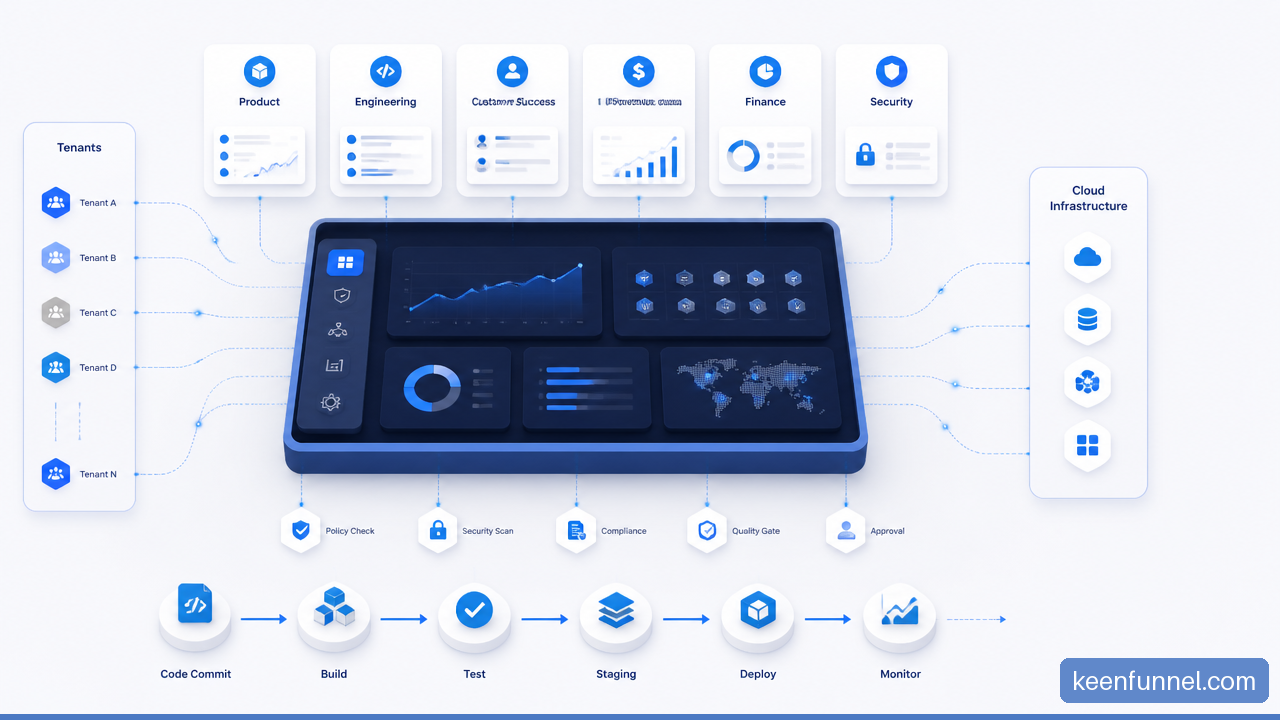
Table Of Contents
• Build A Control Plane, Not A Department Map
• Set Decision Rights And Shared Operating Cadence
• Standardize The Delivery And Tenant Lifecycle
• Connect Revenue, Customer Success, And Service Tiers
• Protect Margin, Security, And Adaptability
Build A Control Plane, Not A Department Map
A scalable SaaS operating model explains how work moves from a market signal to a product decision, a software release, customer adoption, and recurring revenue. It should make those connections visible across product, engineering, RevOps, customer success, finance, security, and support.
The mistake is to design each function in isolation. A product team may prioritize a feature, engineering may deploy it safely, and sales may sell it aggressively, but the business still loses control if customer success cannot onboard users, billing cannot recognize the right entitlement, or support has no clear escalation path.
Treat The Model As A Control Plane
I recommend viewing the operating model as a control plane above daily execution. The control plane does not perform every task. It defines how policies, data, automation, and human decisions direct the work.
It should answer five practical questions:
What is the approved way to do repeatable work? Examples include provisioning a tenant, approving a production change, handling a security event, and escalating a renewal risk.
What data proves that the work happened correctly? This includes audit logs, deployment records, product usage events, customer health scores, support history, and cloud cost data.
Who can decide, approve, or override? Teams need explicit authority, not vague statements that they “collaborate.”
What can be automated safely? Automation should enforce known rules, while ambiguous or high impact exceptions go to an accountable person.
How does the company learn and adjust? Operating reviews should use real telemetry to change priorities, capacity, service levels, and controls.
This approach is consistent with Deloitte’s five digital operating model choices: digital ownership, reporting structure, organizational model, gap closing approach, and team capabilities. The useful implication is that tool selection comes after operating choices. Buying an automation platform will not repair unclear ownership.
Design Around Value Streams
A SaaS company usually scales through a small number of cross functional value streams. Each needs an owner, measures, service expectations, and a documented exception path.
Value Stream | Starts With | Ends With | Primary Outcome |
|---|---|---|---|
Prospect to customer | Qualified demand | Activated paying tenant | Conversion and clean handoff |
Idea to released capability | Validated opportunity | Measured production release | Faster, safer product delivery |
Customer to renewal | Adoption signal | Renewal, expansion, or managed exit | Retention and account health |
Incident to recovery | Alert or customer report | Restored service and follow up actions | Reliability and trust |
Usage to cash | Metered or entitled activity | Accurate billing and margin insight | Predictable revenue and cost control |
For example, an enterprise prospect may ask for a single sign on method, custom data retention, and dedicated support. The operating model should decide whether those requests are product configuration, a premium service, or infrastructure customization. Without that distinction, every large deal can create a new operating burden that erodes margin.
Standardize The Platform, Not Every Request
SaaS scale depends on reusable capabilities. Platform standards should cover identity, deployment, logging, security baselines, integrations, and service monitoring. Customer needs can then be addressed through configuration, entitlements, and published service tiers wherever possible.
SysGenPro’s SaaS operating framework guidance supports this emphasis on platform standardization, automation, governance, and operational resilience. The principle is straightforward: standardize the machinery that serves customers, while allowing controlled flexibility in how customers use the product.
Avoid treating customization as automatically bad. A strategic customer may justify a temporary exception. But it needs four controls: a named sponsor, documented cost, an expiry or review date, and a decision on whether it becomes a supported product capability. Otherwise, “one exception” becomes permanent hidden complexity.
Set Decision Rights And Shared Operating Cadence
Speed declines when people must repeatedly ask who owns a decision. I would define decision rights at the boundaries where functions overlap, because that is where delays, rework, and risk tend to accumulate.
Use A Decision Rights Matrix
A responsible person completes work. An accountable person makes the final call. Those roles should not be confused, especially for high impact workflows.
Decision Or Workflow | Accountable Owner | Required Contributors | Escalate When |
|---|---|---|---|
Product roadmap tradeoff | Product leader | Engineering, RevOps, customer success | A commitment changes revenue, reliability, or compliance risk |
Production release policy | Engineering or platform leader | Product, security, support | Release risk exceeds the approved change threshold |
Security control exception | Security leader | Engineering, legal, service owner | Customer need conflicts with baseline control |
Tenant provisioning standard | Operations or platform owner | RevOps, customer success, support | The request requires manual infrastructure work |
Commercial packaging and SLA | Revenue leader | Finance, customer success, operations | Service commitment changes cost to serve |
Incident severity and communication | Incident commander | Engineering, support, customer success | Customer impact crosses the contractual or reputational threshold |
The table is not bureaucracy for its own sake. It removes a common failure mode: a sales representative promises a capability, an engineer builds a workaround, and finance later discovers that the account cannot meet its expected gross margin.
Run A Cadence That Produces Decisions
Metrics without a meeting rhythm become dashboard decoration. A useful cadence has a different purpose at each level:
• Daily or near real time operational reviews manage incidents, failed jobs, deployment health, and urgent customer blockers.
• Weekly delivery reviews examine release readiness, major defects, implementation capacity, and exceptions to standard processes.
• Monthly business reviews connect product usage, pipeline quality, retention risk, cloud spending, and margin.
• Quarterly operating model reviews revisit service tiers, decision rights, capacity constraints, and recurring exception patterns.
McKinsey’s work on scaling next generation operating models supports a design that simplifies work while orchestrating execution across the business. In practice, this means removing approvals that add no useful control and strengthening the few controls that protect customers, cash, and reliability.
Centralize Guardrails, Federate Execution
There is no universal answer to how centralized a SaaS company should be. A growing company may centralize platform engineering, security, data governance, and pricing rules while allowing product squads, regional sales teams, or customer success segments to act within those guardrails.
Centralize when inconsistency creates shared risk: identity management, production access, cloud commitments, customer data definitions, and incident severity rules. Federate when local context improves results: account plans, customer education, feature discovery, and vertical market messaging.
Fair warning: a federated model fails when each team buys its own automation tools and defines its own customer data. A centralized model fails when every small product decision requires executive approval. The practical balance is governed autonomy.
Standardize The Delivery And Tenant Lifecycle
SaaS has a different operating rhythm from perpetual software. Infosys notes that SaaS operates at a faster pace for product updates, market access, order processing, and billing. That pace requires workflows that are repeatable, observable, and safe under pressure.
Build Golden Paths For Engineering
A golden path is the preferred route for common work. It gives teams a fast default while preserving room for justified exceptions.
For software delivery, the golden path should typically include:
• Version controlled infrastructure as code, so environments can be recreated rather than manually repaired.
• CI/CD pipelines with automated build, test, security, and deployment checks.
• Standard observability for logs, metrics, traces, alerts, service ownership, and runbooks.
• Release rings that move changes through internal, limited, and broad production audiences.
• Clear rollback criteria and communication procedures when a release harms performance or customers.
The mechanism matters. CI/CD is not merely a deployment button. It records what changed, applies consistent checks, limits unauthorized variation, and connects a release to telemetry after it reaches production. If conversion drops or error rates rise after a release, teams should be able to identify the change, affected tenants, owner, and recovery option quickly.
Manage Tenants As A Lifecycle
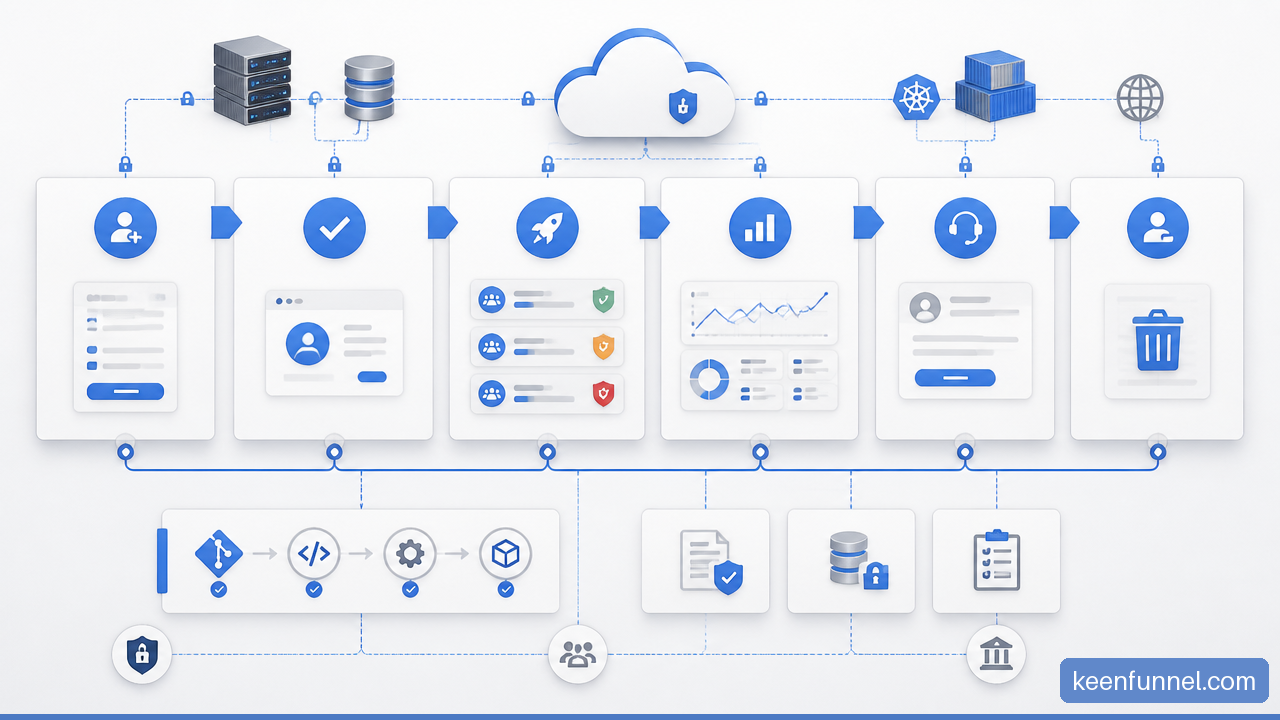
Tenant management should not end when a customer receives login credentials. It needs standards for creation, configuration, access changes, support, suspension, retention, and deletion.
Lifecycle Stage | Operating Standard | Typical Evidence |
|---|---|---|
Provisioning | Validate contract, plan, region, identity, and baseline configuration | Provisioning record and entitlement log |
Activation | Confirm administrator access, integrations, and onboarding milestone | Adoption event and success plan |
Change | Route configuration, access, and integration requests through approved workflows | Change ticket and audit trail |
Release | Use environment and release ring rules before broad exposure | Deployment record and monitoring data |
Suspension Or Exit | Restrict access, preserve data as required, then deprovision on schedule | Offboarding approval and deletion record |
The edge case is the “urgent” enterprise tenant. If a prospect needs a custom sandbox before a deal closes, define who accepts that cost and security responsibility. An unmanaged trial environment can become a forgotten production dependency. A controlled sandbox, by contrast, has an owner, expiry date, access policy, and monitoring baseline.
Automate Repeated Work, Not Unclear Work
SysGenPro’s workflow automation model emphasizes orchestration, ownership, lifecycle management, and automation governance. That is the right sequence. First define the workflow and owner. Then automate stable, repeated steps.
Good candidates include entitlement updates after a signed order, onboarding task creation, health score alerts, renewal reminders, access revocation, deployment approvals based on policy, and incident notifications. Avoid automating an unresolved process. If customer success and sales disagree on who owns an adoption risk, an automated alert only sends the confusion faster.
Connect Revenue, Customer Success, And Service Tiers
A scalable operating model should connect what customers buy to what the company must deliver. RevOps aligns marketing, sales, customer success, and finance around shared customer records, lifecycle stages, and forecasting rules. Product operations closes the loop by translating usage and feedback into product decisions.
Use One Customer Record With Clear Definitions
The goal is not one giant database. It is a governed set of shared definitions. “Active customer,” “qualified opportunity,” “implementation complete,” “at risk,” and “expansion eligible” must mean the same thing wherever the data appears.
A workable metrics tree connects activity to outcomes:
Layer | Example Measures | Decision It Should Inform |
|---|---|---|
Operational activity | Provisioning time, deployment lead time, support response time | Where workflow friction is building |
Customer behavior | Activation rate, feature adoption, unresolved support themes | Whether customers reach value |
Revenue health | Pipeline conversion, GRR, NRR, churn, expansion | Which segments need commercial action |
Economic health | Cost to serve, gross margin, CAC payback, cash impact | Whether growth is financially scalable |
Reliability and risk | Uptime, error budgets, incident recurrence, control exceptions | Whether service promises remain credible |
I would avoid using NRR as the only north star. Strong expansion can conceal churn in a smaller customer group. Pair NRR with gross revenue retention, adoption measures, and support burden by segment.
Make Customer Success A Core Operating Function
Customer success should be embedded in the model because recurring revenue depends on adoption, retention, and expansion. Its responsibilities should include lifecycle design, health signal ownership, risk escalation, onboarding standards, and structured feedback to product and RevOps.
The key is segmentation. A self service plan may receive in product guidance, knowledge base support, and automated adoption prompts. A mid market plan may receive structured onboarding and periodic success reviews. An enterprise tier may include named contacts, integration support, governance reviews, and contractual incident communication.
Service tiers should reflect actual operating cost. Do not promise a 24 hour response target, dedicated solutions support, and custom reporting inside a plan whose margin cannot support it. If a customer needs more, price a higher tier or a professional service. That is not inflexibility. It is an honest operating design.
Protect Margin, Security, And Adaptability
Scale is not simply higher customer volume. It is the ability to add revenue without a proportional increase in manual work, infrastructure cost, risk exposure, or management overhead.
Put FinOps Inside Operating Reviews
FinOps belongs in the SaaS operating model because cloud cost is part of cost of goods sold and gross margin. Finance, engineering, and product need a shared view of what cost is growing, why it is growing, and who can act.
Useful unit economics guardrails include:
• Cloud cost per active tenant, customer segment, or usage unit.
• Support effort and onboarding cost by service tier.
• Infrastructure cost linked to high volume features or integrations.
• Gross margin trends alongside ARR growth and customer mix.
• Exception costs, such as dedicated environments or custom data processing.
For example, a new analytics feature may increase adoption and expansion potential while also sharply raising compute costs. The correct response is not always to stop the feature. It may be to add usage limits, redesign queries, move it into a premium tier, or accept lower margin because the retention benefit is proven. The operating model gives the company a place to make that tradeoff deliberately.
Make Security Part Of Every Workflow
Security and compliance work best when built into normal operating steps, not added as a late stage review. At minimum, each workflow should address identity, access, secrets, auditability, change control, and incident response.
For example:
• Tenant provisioning verifies administrator identity and assigns least privilege access.
• CI/CD checks prevent credentials from entering source code and record production changes.
• Support escalation controls access to customer data and records sensitive actions.
• Offboarding revokes access, handles retention obligations, and confirms deprovisioning.
• Incident response defines severity, technical containment, customer communication, recovery, and follow up actions.
The practical test is simple: if a security event occurs at 2 a.m., can the company identify the affected service, tenant population, decision maker, communication owner, and recovery procedure without searching through private messages? If not, the control is not operational yet.
Roll Out The Model Without Process Theater
Do not attempt to redesign every workflow at once. Start with a narrow set where poor handoffs create visible cost or customer risk: tenant provisioning, release management, incident response, support escalation, and renewal risk management.
Use a phased rollout:
Map the current workflow, including handoffs, systems, approvals, and failure points.
Define one accountable owner, measurable service standard, and exception path.
Build the simplest repeatable process and automate only stable steps.
Train affected teams using real scenarios, not policy documents alone.
Audit adoption through workflow data and revise rules that create avoidable delay.
A model should evolve as the product, customer base, and regulatory demands change. If teams routinely bypass a rule, investigate why. The rule may be necessary, but the path may be too slow or unclear. Flexibility does not mean no standards. It means standards can be improved using evidence.
Key Takeaways
• A scalable SaaS operating model is a control plane connecting policy, telemetry, automation, and accountable execution.
• Define decision rights at functional boundaries, especially for releases, tenant exceptions, security, service commitments, and pricing.
• Standardize platform capabilities and lifecycle workflows while limiting infrastructure customization to approved exceptions.
• Connect activity metrics to customer adoption, retention, gross margin, and reliability outcomes.
• Segment onboarding, support, and escalation by service tier so commercial promises match cost to serve.
• Build FinOps and security controls into regular operating workflows rather than treating them as separate projects.
Frequently Asked Questions
What Teams Should Own A SaaS Operating Model?
No single team can own every part. Executive leadership should sponsor the model, while functional leaders own their relevant decisions. Operations or a transformation lead can coordinate the design, but product, engineering, RevOps, customer success, finance, and security must own their workflows and metrics.
What Processes Should A SaaS Company Standardize First?
Start with processes that are frequent, cross functional, and costly when they fail: tenant provisioning, release management, incident response, customer onboarding, support escalation, and billing or entitlement changes. Avoid beginning with rare edge cases because they create complexity before the core system is stable.
How Do Product, Engineering, And RevOps Work Together?
They should share definitions, planning inputs, and feedback loops. RevOps provides demand, sales cycle, and customer segment data. Product decides which problems merit investment. Engineering defines safe delivery constraints and platform capacity. A regular review should resolve tradeoffs, such as whether an enterprise request becomes product work, a paid service, or a declined exception.
How Do You Decide What To Automate?
Automate work that has clear inputs, repeatable rules, known owners, and measurable outcomes. Keep human approval for ambiguous requests, high value commercial exceptions, security overrides, and changes with material customer impact. If a workflow has frequent disagreements about ownership, clarify the process before automating it.
What Metrics Belong In A Scalable SaaS Operating Model?
Use a linked metrics tree: operational measures such as deployment lead time and provisioning time; adoption measures such as activation and feature use; commercial measures such as GRR, NRR, churn, and expansion; economic measures such as gross margin and cloud cost per tenant; and reliability measures such as uptime and incident recurrence.
How Should SaaS Companies Scale Support And Onboarding Across Customer Tiers?
Define service tiers with explicit support channels, response objectives, onboarding activities, escalation paths, and success coverage. Self service customers should receive effective product guidance and automation. Higher tiers can justify more human support when pricing covers the cost. Do not let informal sales promises create a hidden premium tier.
How Does FinOps Fit Into A SaaS Operating Model?
FinOps connects cloud spending to product decisions, customer usage, and gross margin. It should be reviewed alongside revenue and service performance, not only as a monthly finance variance. This helps teams distinguish productive growth in usage from expensive architecture, idle resources, or unpriced custom commitments.
Sources And References
• Deloitte Insights — Digital operating models: https://www.deloitte.com/us/en/insights/topics/business-strategy-growth/digital-operating-models.html
• McKinsey — Scaling the next-generation operating model: https://www.mckinsey.com/~/media/mckinsey/business%20functions/operations/our%20insights/digital%20service%20excellence/digital-service-excellence--scaling-the-next-generation-operating-model.pdf
• Infosys — Digital future of the software industry: https://www.infosys.com/industries/high-technology/white-papers/Documents/transitioning-saas.pdf
• SysGenPro — SaaS Operating Frameworks for Distribution Cloud Scale: https://sysgenpro.com/saas-operating-frameworks-for-distribution-cloud-scale
• SysGenPro — SaaS Workflow Automation Operating Models for Scalable Operations: https://sysgenpro.com/saas-workflow-automation-operating-models-for-scalable-operations