


AI-Driven Ad Optimization and Attribution can help us make faster advertising decisions, but automation is only as reliable as the data and business goals behind it. A bidding system can move budget toward a campaign with a strong reported ROAS. That does not automatically mean the campaign created additional profit, qualified leads, or long-term customer value.
The practical goal is not to automate every advertising decision. It is to build a connected measurement system that helps us distinguish useful signals from misleading ones. When campaign data, website events, CRM outcomes, and financial results are aligned, AI can reduce manual work while improving control over acquisition costs and revenue quality.
Treat AI As A Decision System, Not A Reporting Layer
AI-driven advertising can evaluate combinations of audiences, bids, placements, timing, and creative far faster than a manual review process. Its value comes from using that analysis to make disciplined budget decisions tied to meaningful outcomes.
We should avoid treating a platform dashboard as a complete source of truth. Platform reporting often uses its own attribution windows, identity rules, conversion definitions, and modeled data. A connected measurement system needs to reconcile those differences with website analytics, CRM records, payment data, refunds, and lead outcomes.
Optimize For Business Value, Not The Easiest Event To Measure
A click, form submission, app install, or trial signup may be useful for learning. It is not always the right optimization target. If low-quality leads complete a form more often than qualified leads, an AI system may scale the wrong audience because it is following the signal it receives.
The conversion event sent to an advertising platform becomes a training target. If the target is shallow, the optimization may become efficient at producing shallow results.
The strongest systems use a hierarchy of conversion signals, validate attribution with controlled tests, and judge performance against profit, qualified pipeline, or customer lifetime value when those measures matter.
How AI Optimizes Advertising Decisions
What Happens Under The Hood
AI-driven ad optimization uses machine learning and data analytics to estimate which combinations of campaign settings are most likely to produce a selected result. The system receives historical and current signals, identifies patterns, and adjusts decisions within the constraints we set.
Common decision inputs include:
• Campaign spend, impressions, clicks, and conversion events
• Audience characteristics, contextual signals, and engagement patterns
• Creative assets, message variations, and placement performance
• Device type, time of day, geography, and on-site behavior
• CRM status, revenue, repeat purchases, or qualified pipeline outcomes
An AI system does not “understand” business strategy in the human sense. It estimates probabilities from available data. If a certain audience, placement, and creative combination repeatedly produces the chosen conversion signal, the system can increase bids or budget around that combination. If conversion volume drops, it may reduce exposure or move budget elsewhere.
StackAdapt describes AI advertising systems as combining first-party, contextual, behavioral, campaign-performance, and modeled conversion signals. The implication is important: the quality of the decision depends on how consistently those signals are collected, defined, and reconciled.
Where Automation Helps Most
Automation is most useful when a team has enough stable conversion data and clear operating limits. For example, an ecommerce company may allow algorithmic bidding to pursue purchases with a target margin threshold. A B2B company with a long sales cycle may instead optimize initially toward qualified meetings, then return closed-won revenue to its measurement system later.
AI can support several operational tasks:
Decision Area | What The System May Adjust | Guardrail To Set |
|---|---|---|
Bidding | Bid level by auction or audience segment | Maximum CAC or minimum expected margin |
Budget Allocation | Spend across campaigns or channels | Daily caps and minimum test budgets |
Creative Selection | Delivery toward higher-performing assets | Fatigue checks and brand-safety review |
Audience Targeting | Priority toward likely converters | Exclusion rules and fairness review |
Placement Selection | Delivery across inventory sources | Viewability, fraud, and suitability controls |
The right guardrail depends on the business model. For a business with limited sales capacity, more leads are not automatically better. The system should incorporate capacity, lead qualification, and response-time limits rather than maximizing form fills alone.
Creative Analytics Need Context
Creative analytics can reveal which images, videos, offers, and messages correlate with conversions. That makes creative review more disciplined, but it does not remove the need for testing.
Consider two ads. One uses a discount and drives many first purchases. The other explains a premium service and produces fewer purchases but a higher repeat-order rate. If we optimize only for immediate ROAS, the discount ad may receive more budget. If we optimize for gross profit after returns and repeat purchases, the premium message may be more valuable.
Creative performance should therefore be evaluated at more than one level:
Delivery performance: Did the creative earn attention at an acceptable cost?
Conversion performance: Did it produce purchases, leads, or another meaningful action?
Value performance: Did those conversions produce margin, qualified pipeline, retention, or lifetime value?
Why Attribution Is Not Incrementality
Attribution Assigns Credit; Incrementality Tests Cause
Attribution answers a descriptive question: Which tracked interactions should receive credit for a conversion? Incrementality answers a causal question: Would the conversion still have happened without the advertising exposure?
These questions are related, but they are not interchangeable. An ad can receive attribution credit because it was the last measurable interaction before a purchase. The buyer may still have purchased through direct traffic, organic search, an existing relationship, or another channel without seeing that ad.
Cometly’s explanation of multi-touch attribution notes that it distributes credit across several customer interactions rather than assigning all credit to the final interaction. This can create a fuller view of a customer journey than last-click reporting. Still, fractional credit is not proof that each credited touchpoint caused part of the sale.
For budget decisions, we should use attribution as a directional signal and incrementality testing as the validation layer. This is especially important for branded search, retargeting, loyalty audiences, and channels that reach people already close to converting.
Use Holdouts And Geo-Experiments For Causal Checks
A holdout test deliberately withholds advertising from a comparable audience segment. A geo-experiment compares similar geographic areas where a campaign change is applied in one group but not the other. These methods create a counterfactual: an estimate of what may have happened without the intervention.
For instance, suppose an AI system recommends doubling spend on retargeting because retargeting reports a 9:1 ROAS. Instead of immediately scaling everywhere, we could keep a small matched audience unexposed for a defined period. If exposed users buy at a meaningfully higher rate than the holdout group, the campaign has stronger evidence of incremental value. If rates are similar, the reported ROAS may largely reflect demand that already existed.
No test design is perfect. Small audiences may produce noisy results, and geo areas may differ in seasonality, inventory, or local competition. Fair warning: a weak experiment can create false confidence. The answer is not to abandon testing, but to document assumptions, use sufficiently long test periods, and avoid major budget shifts when results remain uncertain.
Attribution Windows Can Change Campaign Rankings
An attribution window is the period after a click or view during which a conversion can receive credit. A short window can undercount long consideration cycles. A long window can over-credit ads that appeared early but had limited influence on the final decision.
Window selection should reflect the actual buying cycle. WiseSuite, for example, describes different configurations for impulse purchases, SaaS trials, and longer B2B purchases rather than treating one default window as universally correct. That logic is sound: a seven-day click window may fit a low-cost consumer product, while a 28-day click window may better match a longer B2B evaluation process.
We should run sensitivity analysis before reallocating budget. Compare campaign rankings under two or three reasonable window settings. If a campaign looks excellent only under one unusually long view-through window, its reported advantage deserves caution.
Building A Reliable Conversion Signal System
Define A Signal Hierarchy Before Connecting Tools
A reliable AI-driven advertising system starts with a conversion-signal hierarchy. This helps separate early indicators from outcomes that reflect real business value.
Signal Level | Example Events | Best Use | Main Risk |
|---|---|---|---|
Engagement | Video view, page view, add to cart | Creative and audience learning | High volume, low business value |
Intent | Form start, trial signup, checkout start | Short-term optimization | Can favor low-intent users |
Core Conversion | Purchase, booked meeting, qualified lead | Primary campaign optimization | May arrive with delay |
Value Outcome | Margin, closed-won revenue, repeat purchase | Budget allocation and strategy | Requires CRM and finance integration |
For many organizations, the practical answer is a staged approach. Use higher-volume events to help new campaigns learn, then shift optimization toward verified purchases, qualified leads, or pipeline as enough data becomes available. Avoid sending every event back to a platform simply because it can be tracked. Each event should have a clear role.
Reconcile Data Before Calling It A Single Source Of Truth
Ad platforms, web analytics tools, CRM systems, ecommerce platforms, and finance systems often disagree. That does not always mean one system is broken. They may be using different time zones, attribution windows, conversion timestamps, identity rules, or deduplication logic.
A cross-channel reconciliation process should document:
Conversion definition: What exactly counts as a lead, sale, or qualified opportunity?
Timestamp rule: Is credit assigned at ad interaction, web conversion, payment, or CRM qualification?
Identity rule: How are users matched across browser sessions, devices, and CRM records?
Deduplication rule: How are browser, server-side, CRM, and platform events prevented from counting the same conversion twice?
Reporting cadence: When are delayed conversions and offline outcomes reconciled?
This work may sound operational rather than strategic. It is both. A model trained on duplicated conversions can overstate a campaign’s performance and push more budget into an already distorted result.
Privacy Changes Require Better Data Discipline
Third-party cookies, browser restrictions, consent choices, and mobile operating-system limits reduce the amount of directly observable customer-path data. AI attribution can still operate, but it often relies more heavily on first-party data, contextual signals, anonymized identifiers, and modeled conversions.
Modeled conversions can be useful, especially when direct measurement coverage is incomplete. We should not treat them as equally certain across every channel. A trustworthy report labels what is directly observed, what is matched through identity resolution, and what is estimated.
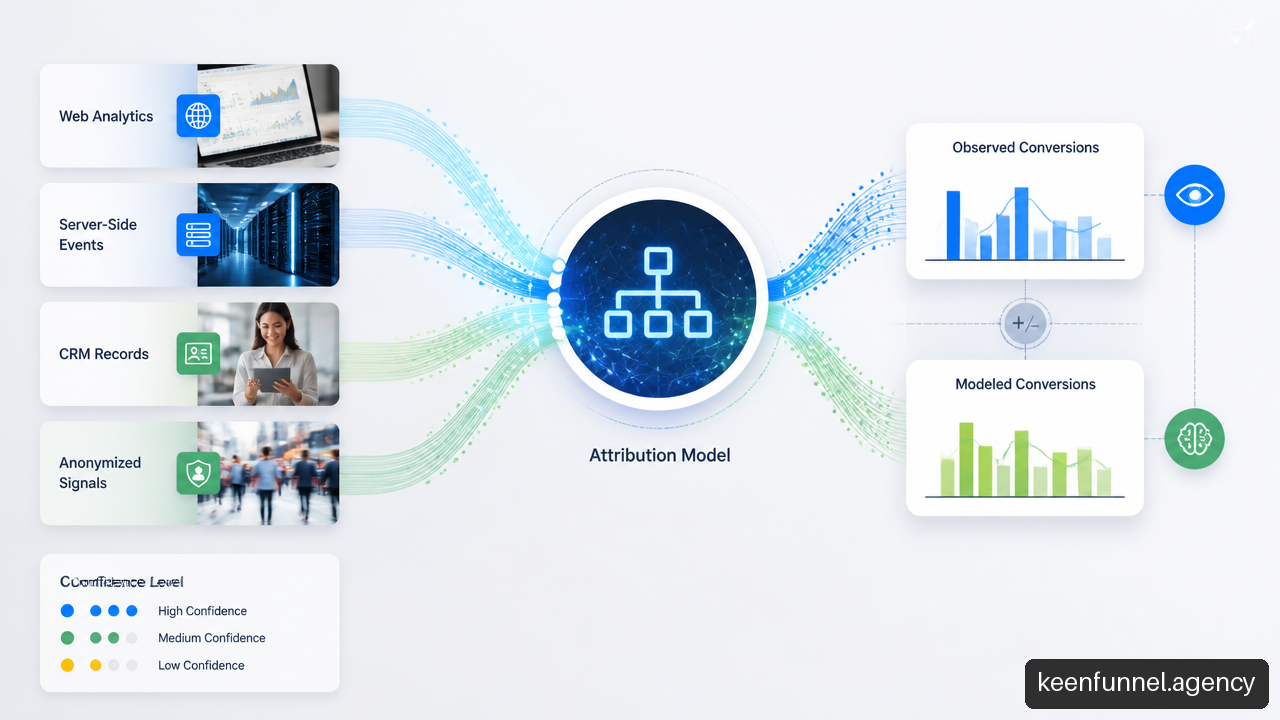
A simple uncertainty label can improve decision quality:
• High confidence: Strong event coverage, stable conversion volume, clear deduplication, and consistent CRM matching
• Medium confidence: Some modeled observations or delayed CRM outcomes, but stable directional results
• Low confidence: Sparse conversions, major identity gaps, changing definitions, or inconsistent data delivery
This prevents a precise-looking dashboard from creating false certainty. A recommendation based on 20 verified purchases should be treated differently from one based on thousands of reconciled transactions.
Validating AI Recommendations Before Scaling
Separate Optimization Latency From Reporting Latency
Optimization latency is the time required for an advertising system to learn and adjust. Reporting latency is the time required for the business outcome to become visible and trustworthy. These are not the same.
A consumer purchase may be recorded within minutes. A B2B lead may take weeks to qualify and months to close. If we judge a campaign after three days using only form submissions, we may reward sources that generate fast but weak leads and underfund sources that create slower, higher-value opportunities.
Set reporting expectations by funnel stage. Daily monitoring may be appropriate for delivery failures, spend spikes, and broken tracking. Weekly or monthly reviews may be more suitable for qualified pipeline, margin, refunds, and customer retention.
Watch For Feedback Loops And Bias
Feedback loops occur when an AI system learns from data shaped by its own earlier decisions. If it directs delivery toward one audience, it collects more conversion data from that audience. The model may then become more confident that the audience is best, even if other groups had less opportunity to respond.
This can also affect creative decisions. If a platform gives most impressions to one early “winner,” competing assets may never receive enough delivery to prove their value. The result is not necessarily fraud or malfunction. It is a structural risk in optimization systems that learn from uneven exposure.
Useful recovery actions include:
• Reserve a controlled test budget for new audiences, placements, and creatives
• Review conversion quality by segment, not only total campaign volume
• Set exclusion rules for poor-fit or overexposed audiences
• Audit whether model recommendations rely on duplicated, delayed, or shallow events
• Pause major changes when tracking definitions or CRM workflows change
Evaluate Profit, Capacity, And Customer Value
ROAS remains useful because it connects revenue to ad spend. Yet revenue is not profit, and profit is not always the only constraint. A campaign can show strong ROAS while producing heavily discounted orders, high return rates, low-margin products, or leads that overwhelm the sales team.
A better decision model asks what the business is trying to maximize. Consider these choices:
Business Condition | Better Primary Metric | When ROAS Alone Is Insufficient |
|---|---|---|
High-margin ecommerce | Contribution margin after ad spend | Returns, discounts, and shipping costs vary |
B2B lead generation | Qualified pipeline or closed-won revenue | Lead quality differs sharply by channel |
Subscription business | Predicted lifetime value or payback period | Early revenue does not reflect retention |
Capacity-constrained service business | Qualified leads within sales capacity | More leads cannot be handled effectively |
AI should be allowed to optimize within these commercial constraints. Otherwise, the system may improve a dashboard metric while creating operational strain elsewhere.
Frequently Asked Questions
What Is AI-Driven Ad Optimization And Attribution?
AI-driven ad optimization uses machine learning to adjust bids, budgets, targeting, placements, and creative toward selected outcomes. Attribution connects advertising interactions to conversions across a customer journey. Together, they can guide budget decisions, provided the conversion data is accurate and the results are validated.
Is AI Attribution Better Than Last-Click Attribution?
It can provide a broader view because it recognizes more than the final tracked interaction. However, broader credit assignment is not automatically more accurate. Use multi-touch attribution for journey analysis, but validate major budget decisions with incrementality tests where practical.
Which Conversion Event Should We Optimize Toward?
Choose the deepest event that has enough volume and reflects business value. A purchase is often better than an add-to-cart event. A qualified lead is often better than a raw form fill. If deeper outcomes are too delayed or scarce, use a staged model that starts with an intent signal and later incorporates verified revenue or pipeline data.
Can AI Attribution Work Without Third-Party Cookies?
Yes, but measurement will be less complete in some cases. Systems can use first-party data, server-side conversion tracking, contextual signals, consented identifiers, and modeled conversions. Results should clearly distinguish observed data from estimates.
Why Do Ad Platform Results Differ From CRM Or Analytics Results?
Different systems may use different attribution windows, time zones, identity matching rules, conversion definitions, and deduplication methods. Reconcile the systems before deciding which metric drives budget allocation. The CRM or transaction system is often closer to final revenue quality, while platform reporting is useful for delivery optimization.
How Can We Test Whether An AI Budget Recommendation Actually Works?
Use a controlled holdout, geo-experiment, or structured before-and-after test with stable comparison conditions. Measure the change in incremental conversions, qualified pipeline, or profit rather than relying only on attributed conversions. Start with a limited budget change when uncertainty is high.
Should We Optimize For ROAS, Profit, Or Customer Lifetime Value?
Choose the metric that reflects the real commercial objective. ROAS may be sufficient for simple, consistent-margin transactions. Profit is better when margins, discounts, or returns vary. Customer lifetime value is more useful for subscriptions and repeat-purchase businesses, although it requires longer reporting cycles and stronger data integration.
How Can We Detect A Bad AI Feedback Loop?
Look for sudden concentration of spend in one audience or creative, declining lead quality despite improving platform results, inconsistent outcomes after tracking changes, or campaign gains that disappear during holdout tests. Maintain test budgets and review the underlying conversion signals before allowing large automated reallocations.
Sources And References
cometly.com — https://www.cometly.com/post/ai-ad-optimization
socialmediatoday.com — https://www.socialmediatoday.com/news/reddit-introduces-updated-options-for-advertisers/820793/
stackadapt.com — https://www.stackadapt.com/resources/blog/ai-advertising-targeting

