


Referral Marketing Automation turns customer recommendations into a coordinated acquisition system. Instead of tracking links in spreadsheets, manually approving rewards, and chasing missing data across tools, we can connect referral events to CRM records, ecommerce transactions, lifecycle campaigns, and reporting.
The goal is not simply to issue rewards faster. A reliable program must know who referred whom, what action qualifies as a conversion, whether the transaction remains valid, and whether the same reward has already been issued. When those rules are clear, referral marketing can become a measurable channel rather than an informal request for word of mouth.
Table Of Contents
• Build A Referral System Before Automating It
• Create Reliable Attribution And Reward Workflows
• Choose The Right Referral Marketing Automation Stack
• Measure Referral Performance Beyond Referral Counts
• Key Takeaways
• Frequently Asked Questions
Build A Referral System Before Automating It
Referral marketing automation is the use of connected software and rules to capture referrals, identify advocates and referred customers, validate outcomes, issue incentives, and report performance. It should reduce manual work, but automation cannot repair unclear program rules.
A referral link can identify an advocate. A referral code can provide a fallback when a customer shares an offer offline or uses another device. Neither, on its own, proves that a reward should be paid.
Referral workflow automation can connect referral activity with CRM, ecommerce, marketing, and reward workflows. That coordination matters because the data needed to qualify a referral is often distributed across several systems.
Define The Conversion Event First
Before choosing technology, define the exact event that creates referral credit and the separate event that makes a reward eligible. These are related, but they are not the same decision.
For an ecommerce store, a conversion may be a paid order above a minimum value. For a SaaS company, it may be a subscription that remains active through a trial period. For a service business, it could be an attended consultation that meets a qualification standard.
Write the rule in plain language:
A referral receives attribution when a new customer completes a qualifying purchase within 30 days of clicking an advocate link. The advocate reward is released 21 days after payment if the order is not refunded, charged back, or flagged for review.
This statement answers questions that software settings often hide:
What counts as a new customer?
What action counts as a conversion?
How long can attribution last?
What happens if the customer cancels or returns the product?
Can an advocate earn more than one reward from the same person?
Without these answers, an automated reward is just a fast way to create disputes.
Separate Attribution From Reward Eligibility
Attribution records the relationship between an advocate and a referred customer. Reward eligibility applies the program’s commercial and risk rules to that relationship.
Consider a customer who uses an advocate’s code, completes a purchase, and later requests a refund. The referral may remain attributed for reporting, because the advocate did influence the purchase. Yet the reward should stay pending or be reversed under the program rules.
This separation improves reporting. If attribution disappears whenever a reward is denied, teams lose visibility into refund patterns, fraud reviews, and the true volume of attempted referral conversions.
Automated referral programs can track referrals, confirm conversions, screen duplicate or self referrals, and issue rewards. The practical implication is that reward delivery should be the final stage of a controlled process, not the first response to a click or form submission.
Use A Minimum Event Data Model
Reliable automation depends on consistent fields moving between systems. We do not need a complex data warehouse to start, but we do need enough detail to investigate exceptions.
Field | Why It Matters | Example Value |
|---|---|---|
Advocate ID | Identifies the person receiving credit | cust_10482 |
Referred customer ID | Connects the referral to a customer record | cust_20915 |
Referral link or code ID | Identifies the attribution method | ref_spring_10482 |
Event timestamp | Applies attribution windows and audits sequence | 2026-04-12T14:15:00Z |
Order or subscription ID | Connects conversion to revenue | order_88319 |
Campaign ID | Separates offers and reward structures | welcome_bonus_q2 |
Eligibility status | Shows pending, approved, rejected, or reversed state | pending_hold |
Reward transaction ID | Prevents duplicate payout | reward_55172 |
Keep the original event timestamps. Replacing them with the time an integration processed the event can create errors when webhooks are delayed or retried.
Create Reliable Attribution And Reward Workflows
A strong workflow handles the ordinary customer journey and the messy exceptions. The core sequence is simple; the controls around it are where most program risk sits.
Map The Referral Lifecycle
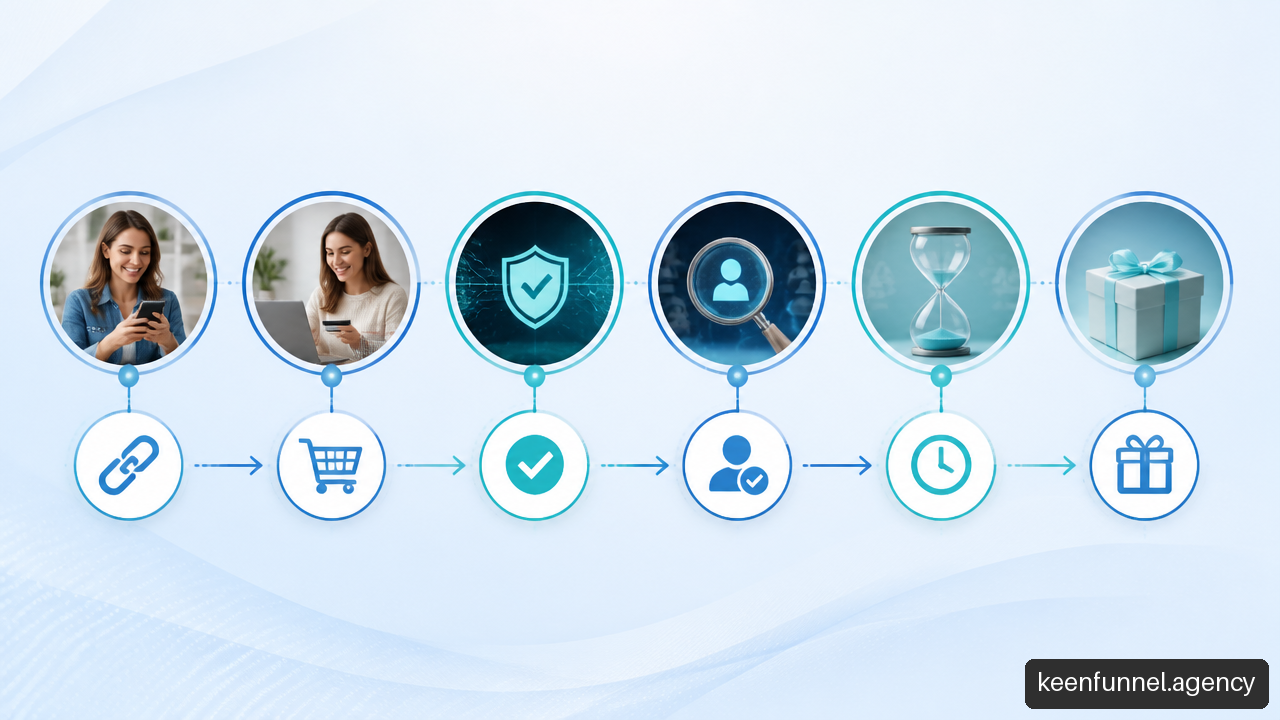
A useful referral lifecycle usually has these stages:
Enrollment: An eligible customer receives a unique referral link or code.
Capture: A prospect clicks the link, submits a form, enters a code, or reaches a tracked landing page.
Attribution: The system stores the advocate, campaign, timestamp, and referred customer relationship.
Conversion: A qualifying business event occurs, such as a paid order or activated subscription.
Validation: Rules check customer status, order value, payment state, fraud indicators, and program limits.
Hold: The reward waits through a return, cancellation, or chargeback window.
Release: The system issues a reward once all requirements are met.
Reconciliation: A scheduled review compares referral records with source transactions and identifies missing or inconsistent events.
The hold stage is often overlooked. Immediate rewards may feel generous, but they can create unnecessary recovery work if a transaction is refunded. A short hold period may be reasonable when return rates or cancellation risk are meaningful. The appropriate duration depends on the business model. A digital product with no refund policy may need a different rule than a subscription service with a 30 day cancellation window.
Make Reward Processing Idempotent
Idempotency means that processing the same event more than once produces one effective outcome. It is a technical term with a straightforward business purpose: one qualified referral should create one reward.
Webhooks can be delivered twice. An ecommerce platform may retry an event after a timeout. A payment status can be replayed after an integration outage. If the reward workflow treats every incoming event as new, a customer can receive duplicate credits or gift cards.
Use a stable idempotency key, such as the combination of referral ID, qualifying order ID, reward type, and advocate ID. Before issuing a reward, the automation should check whether that key already has a completed reward transaction.
Fair warning: this control does not eliminate every dispute. It does prevent one of the most common operational failures, where a technically valid retry becomes a second payout.
Build Fraud And Exception Rules Into The Flow
Referral fraud is not limited to obvious fake accounts. It can include an advocate creating another account, repeated signups from the same device, or unusually high activity that suggests automated behavior.
Referral systems can apply event tracking, identity checks, velocity controls, and eligibility rules to identify risk patterns. These signals should guide review, not automatically label every unusual customer as fraudulent.
A practical ruleset can include:
• Matching advocate and referred customer email addresses
• Matching payment methods, shipping addresses, or phone numbers where appropriate and lawful
• Device and network signals used as review indicators rather than sole proof
• Purchase minimums before reward eligibility
• Velocity checks for a sudden concentration of referrals or redemptions
• Referral limits by advocate, campaign, or time period
• Manual review for events that fall near rule thresholds
Privacy also deserves attention. If advocates are invited to submit friends’ contact details, collect only what the process requires, explain how the information will be used, and retain consent records where relevant. A lower friction campaign is not automatically a better campaign if it introduces unclear data practices or unwanted outreach.
Plan For Missed Events And Manual Recovery
Real time automation should not be your only safeguard. A failed webhook, disconnected CRM integration, or delayed payment event can leave a legitimate customer without credit.
Use a recovery process with three parts:
Audit logs: Record incoming events, decisions, status changes, and reward identifiers.
Dead letter queue: Store events that fail processing so they can be reviewed instead of disappearing.
Reconciliation job: Compare completed orders or subscriptions against referral conversions at a regular interval.
For example, if an order exists in the ecommerce platform but no matching referral conversion appears within 24 hours, the reconciliation job can create an exception. A team member can then decide whether attribution is justified, rather than relying on a customer complaint as the first warning.
Choose The Right Referral Marketing Automation Stack
The best technology choice depends on program complexity, event volume, data ownership, fraud exposure, and available technical support. More software does not necessarily create more control.
Compare Dedicated Platforms, CRM Workflows, And Custom Automation
Option | Best For | Strengths | Watch For |
|---|---|---|---|
Dedicated referral platform | Programs needing advocate portals, rewards, campaign controls, and fraud features | Faster launch and purpose built workflows | Limited flexibility or data portability in some tools |
CRM and marketing automation | B2B or lifecycle focused programs with simple referral rules | Strong lead routing and nurture sequences | May lack robust reward and fraud controls |
No code workflow automation | Connecting existing tools for moderate complexity | Flexible integrations and quick prototypes | Retry handling and data governance need careful design |
Custom integration | High volume or unusual business rules | Full control over data model and logic | Higher engineering, testing, and maintenance cost |
Referral software commonly includes tracking, rewards management, and campaign management functions. Those features may be enough for many programs, especially when the reward model is simple and customer data already lives in a connected platform.
Choose a dedicated platform when you need configurable campaigns, advocate experiences, reward catalogs, and built in controls without building them from scratch. Choose custom automation when program rules depend on proprietary events, complex subscription states, multiple currencies, or strict data governance requirements.
Avoid a heavily customized system at launch if the actual offer has not been tested. First validate whether customers understand the referral proposition, whether the incentive produces qualified demand, and whether support teams can explain the rules clearly.
Connect Automation To Customer Follow Up
Referral value can be lost when a new lead is captured but no one follows up. A referred prospect may deserve a different journey from a cold lead because they already have some context from the advocate.
Automation can route a referred B2B lead to the correct sales owner, attach referral source data to the CRM record, and start a nurture sequence when sales readiness is low. In ecommerce, it can connect a code redemption to post purchase loyalty messages and reward notifications.
The key is to preserve source data. If a CRM overwrites “referral” with a later campaign touch, attribution reporting becomes unreliable. Use separate fields for original acquisition source, referral advocate, last interaction, and campaign membership.
Measure Referral Performance Beyond Referral Counts
Referral counts are useful, but they are not enough to determine whether a program improves customer acquisition economics. A program can generate many referrals that never convert, rewards that erode margin, or purchases that would have happened without an incentive.
Track The Full Funnel And Unit Economics
Use a shared definition for each metric. This reduces arguments between marketing, finance, sales, and operations.
Metric | Calculation | Decision Use |
|---|---|---|
Referral participation rate | Advocates sharing ÷ eligible advocates | Measures program adoption |
Referral conversion rate | Qualified referred customers ÷ referred prospects | Tests referral quality and offer fit |
Reward cost per acquisition | Total reward cost ÷ qualified new customers | Shows incentive efficiency |
Referral CAC | Reward cost plus program cost ÷ acquired customers | Compares referral acquisition with other channels |
Revenue per referred customer | Referred customer revenue ÷ referred customers | Measures near term commercial value |
Customer lifetime value | Expected gross margin over customer relationship | Evaluates long term quality |
Reward reversal rate | Reversed rewards ÷ issued rewards | Signals refunds, abuse, or weak hold rules |
Do not assume referral customers are automatically more valuable. Compare their retention, gross margin, and service costs with similar non referred customer groups over the same period. If the program rewards a low margin first purchase but attracts customers who never return, the headline conversion rate can hide a weak ROI.
Test Incrementality, Not Just Attribution
Attribution asks, “Which advocate or campaign received credit?” Incrementality asks, “Did the program create additional business that would not otherwise have happened?”
This is harder to measure, and there is no single universal method. A practical starting point is to compare an eligible audience exposed to the program with a similar group that is not yet exposed, while controlling for timing and major promotions.
For example, a retailer could roll out a referral offer to half of its loyalty members, then compare new customer acquisition, reward cost, and repeat purchase patterns against the holdout group. The result may still be imperfect because customer groups differ. Yet it is more informative than claiming every attributed referral was entirely caused by the reward.
When a controlled test is not possible, track trends before and after launch, document other campaigns running at the same time, and state the uncertainty honestly.
Key Takeaways
• Referral Marketing Automation works best when referral attribution, conversion validation, and reward eligibility are treated as separate decisions.
• Define the qualifying event, attribution window, refund rule, cancellation rule, and reward hold period before configuring software.
• Store event level data, including customer IDs, campaign IDs, timestamps, transaction IDs, statuses, and reward identifiers.
• Use idempotency checks, audit logs, dead letter queues, and reconciliation jobs to prevent duplicate rewards and recover missed events.
• Match the technology stack to program complexity rather than buying the largest feature set available.
• Measure referral CAC, reward cost, revenue, retention, reversals, and incrementality alongside raw referral counts.
Frequently Asked Questions
What Is Referral Marketing Automation?
Referral Marketing Automation uses software and connected workflows to manage referral links or codes, track advocates and referred customers, validate conversions, deliver rewards, and report outcomes. It replaces repetitive administration while keeping program rules consistent.
How Does Automated Referral Tracking Work?
A referral link, code, or tracked form captures an advocate identifier. When the referred customer later signs up, purchases, or activates a service, the system matches that event to the stored attribution record. The match should be governed by an attribution window and customer eligibility rules.
Which Referral Events Should Trigger A Reward?
A reward should generally follow a business event with real value, such as a completed paid order, cleared payment, activated subscription, or qualified sales opportunity. Avoid rewarding clicks, raw signups, or unverified forms unless those actions are genuinely valuable to the business.
Should Rewards Be Issued Immediately Or After A Holding Period?
Immediate rewards can work for low risk events with no return or cancellation exposure. A holding period is usually safer when purchases can be refunded, subscriptions can cancel quickly, or fraud risk is material. The hold should align with the actual refund, chargeback, or cancellation policy.
How Can A Business Prevent Self Referrals And Fake Accounts?
Use multiple signals, including email and phone checks, purchase requirements, account age, payment and address comparisons, velocity rules, and manual review for unusual patterns. No single signal is perfect, so the goal is risk reduction rather than an unrealistic promise of zero fraud.
Is A Dedicated Referral Platform Better Than No Code Automation?
A dedicated platform is often better for ready made advocate experiences, reward management, and campaign controls. No code automation may be suitable for simpler workflows or connecting systems already in use. Custom approaches become more appropriate when the program needs unusual eligibility logic, high scale, or strict data control.
How Should A Business Handle Refunds, Cancellations, And Chargebacks?
Keep the referral attribution record, but move the reward into a pending, denied, or reversed state based on policy. If a reward was already issued, define whether the business will claw it back, offset it against future rewards, or treat it as a cost of the program.
How Can We Tell If A Referral Program Is Creating New Demand?
Use incrementality testing where possible. Compare a group exposed to the referral program with a similar holdout group, then review differences in qualified acquisition, revenue, retention, and reward cost. Attribution alone shows where credit was assigned; it does not prove that the incentive created every conversion.
Sources And References
• Zapier — Referral Marketing Automations & AI Workflows: https://zapier.com/automations/marketing/referral-marketing
• Referral Factory — Automated Reward Delivery: https://referral-factory.com/learn/automating-customer-referral-programs
• Extole — Referral Program Automation: Guide for Growth Teams: https://www.extole.com/blog/referral-program-automation/
• Shopify — 4 Referral Automation Tools for Ecommerce Stores: https://www.shopify.com/blog/referral-automation
• Capterra — Best Referral Software: https://www.capterra.com/referral-software/
Ecommerce referral automation commonly includes unique links or codes, reward delivery, and referral reporting, which makes it useful for operational visibility as long as the underlying qualification rules are clearly defined.

