


Prompt Research helps us identify the questions people bring to answer engines, understand the answers they receive, and build content around the decisions that matter. It is not a shortcut to guaranteed visibility. It is a disciplined way to replace assumptions with observed language, clear evidence, and repeatable testing.
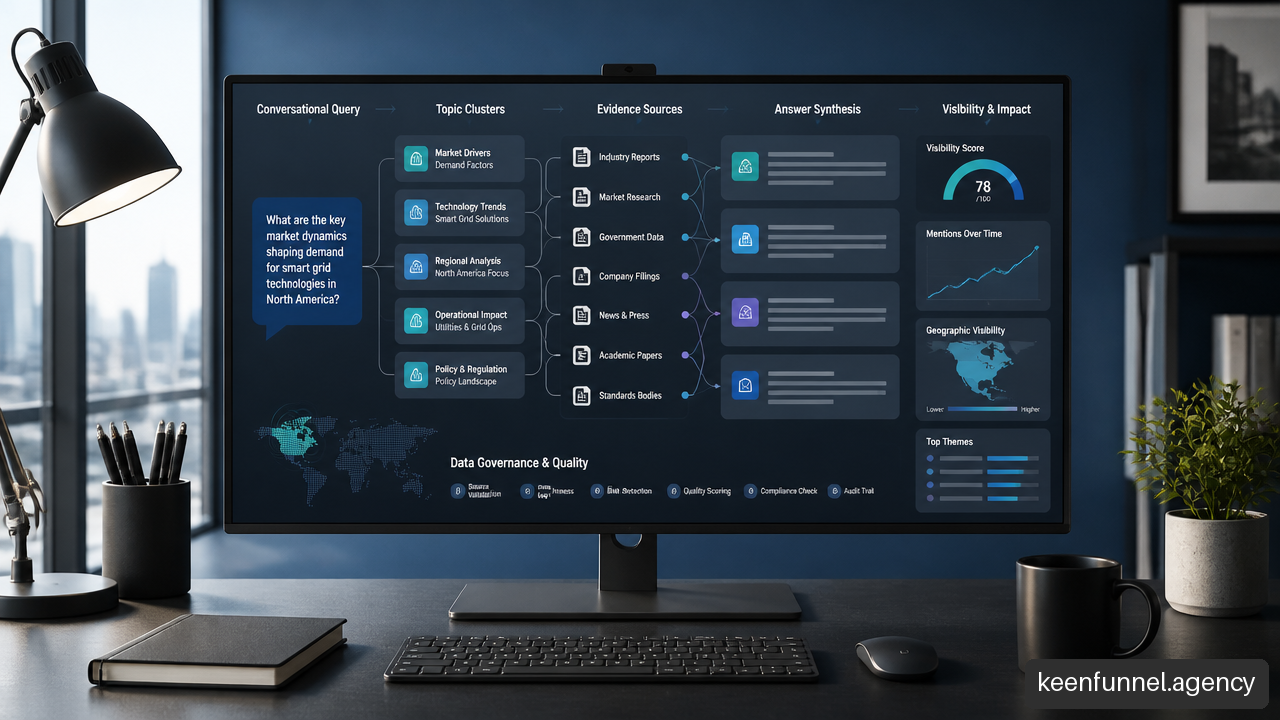
Table Of Contents
Navigate This Guide
What Prompt Research Should Measure
Define The Work Before Collecting Prompts
Prompt Research is the process of discovering, organizing, evaluating, and prioritizing questions submitted to generative answer systems. For a business, its practical purpose is simple: identify the questions that shape customer decisions, then determine whether the available answers accurately represent the business, its expertise, and its evidence.
The useful unit is rarely one exact sentence. A customer might ask, “What is the best automation platform for a growing service business?” Another might ask for “software to connect forms, sales follow ups, and reporting.” The wording differs, but the underlying goal may be the same: compare practical automation options for a growing business.
This is why topic level analysis matters. SISTRIX’s German prompt research overview describes grouping individually worded prompts into broader topics so demand can be analyzed beyond exact phrasing. Its related topic based prompt research explanation makes the same distinction: prompts can share a subject and a user goal even when their wording changes.
We should treat Prompt Research as three connected but separate activities:
Activity | Core Question | Useful Output | Common Mistake |
|---|---|---|---|
Prompt discovery | What language do people use? | A source tagged prompt set | Treating generated variants as proof of user behavior |
Answer analysis | What does a system say in response? | Mentions, citations, claims, and omissions | Assuming one answer represents a stable result |
Visibility measurement | How often and how well does a brand appear? | Repeated observations by platform, region, and time | Counting every mention as equally valuable |
Separating these activities prevents a frequent reporting problem. A tool may show a large prompt list, but that does not prove each prompt comes from direct user logs. A brand may appear in one answer, but that does not prove it is consistently recommended. Clear boundaries make the resulting decisions more trustworthy.
Use An Evidence Taxonomy
Not all prompt sources deserve the same confidence. We recommend labeling each record by origin before clustering or scoring it. This keeps observed customer language separate from useful but speculative expansions.
Evidence Type | Examples | Confidence For Language Research | Best Use |
|---|---|---|---|
Directly observed | Site search, support tickets, chat transcripts, sales notes | High | Exact wording, recurring objections, customer terminology |
Customer reported | Interviews, surveys, account reviews | Medium to high | Context, urgency, decision criteria |
Search derived | Search Console queries, paid search terms, internal search data | Medium | Topic discovery and language support |
Competitor derived | Competitor pages, reviews, comparison pages | Medium | Market framing and gap analysis |
Synthetic | Model generated variations and expansions | Low as demand evidence | Ideation, scenario coverage, wording tests |
Synthetic expansion is still useful. It can expose missing questions such as implementation risk, data migration, or pricing logic. Fair warning: it should never be presented as observed demand without a stated measurement basis.
A practical example illustrates the difference. If support tickets repeatedly ask, “Can this connect with our CRM without manual exports?” that is direct evidence of a real operational concern. If a model suggests, “How do I orchestrate cross functional data synchronization?” it may be a useful editorial angle, but it is not proof that customers use that phrase.
Measure Answer Quality, Not Just Presence
A brand mention is not automatically a win. An answer can mention a company as a passing example, place it in a weak comparison, cite it for an unrelated claim, or state something inaccurate. The better question is: what role did the brand play in the answer?
We recommend recording at least five fields for each test:
• Whether the brand is mentioned
• Whether it is recommended, compared, or merely listed
• Whether a source is cited and whether that source is relevant
• Whether the description is accurate and current
• Whether the answer gives the reader a reasonable next step
Consider a local service business. An answer that says, “Several providers may help,” and lists the business among ten names has low commercial value. An answer that explains the company’s relevant service, cites an authoritative page, and distinguishes it from alternatives has much higher value. Counting both as one “mention” hides that difference.
Visibility without accuracy can create a reporting win and a customer trust problem at the same time.
How To Build A Reliable Prompt Research System
Set The Scope Before You Test
A defensible study starts with scope controls. Answer systems can vary by platform, model version, account state, location, language, time, and conversation history. If those conditions are not recorded, apparent changes may be caused by the test environment rather than by the brand or content.
Platform and region should be separate dimensions, not filters added at the end. Semrush’s platform and regional segmentation feature reflects why this distinction matters: the same customer need can produce different answers across systems and locations.
For example, “best bookkeeping software for contractors” may call for different providers, tax rules, currencies, and local citations in the United States, Canada, and the United Kingdom. A national strategy built from one regional result can misdirect content investment.
Before testing, document the following controls:
Platform and version: Record the answer system and any visible model designation.
Region and language: Use the market, language, and locale relevant to the decision.
Account condition: Note whether the account is signed in, personalized, or fresh.
Session design: Test key prompts in a new conversation unless multi turn behavior is the subject.
Date and time: Record when the answer was captured because systems and indexes change.
Prompt format: Preserve the exact prompt, including follow up context when used.
There is no established industry standard for sample size or statistical confidence in this kind of visibility work. That uncertainty should change the reporting language. A result from one answer is an observation. A result that repeats across controlled runs is stronger evidence, but it is still subject to future change.
Sample For Volatility Instead Of Assuming Stability
Prompt volatility is the degree to which answers, citations, or recommendations change across repeated tests. It can arise from model updates, fresh sources, different retrieval choices, safety rules, or simply the non deterministic nature of generation.
For high value prompts, we recommend repeated tests rather than a single screenshot. A sensible starting approach is to run the same priority prompt several times under the same conditions, then repeat at planned intervals. The objective is not to claim perfect precision. It is to detect whether an observed result is stable enough to guide investment.
Result Pattern | Interpretation | Recommended Response |
|---|---|---|
Brand appears consistently with accurate context | Stronger visibility signal | Protect and improve the cited supporting pages |
Brand appears inconsistently | Volatile signal | Investigate source quality, competing evidence, and prompt wording |
Brand is absent while competitors appear repeatedly | Clearer gap | Create or strengthen evidence for the unmet decision need |
Citations change but the answer stays similar | Source instability | Track source types and avoid overreacting to one citation |
Answer is inaccurate or contradictory | Quality risk | Correct owned content, document the issue, and avoid using it as a success metric |
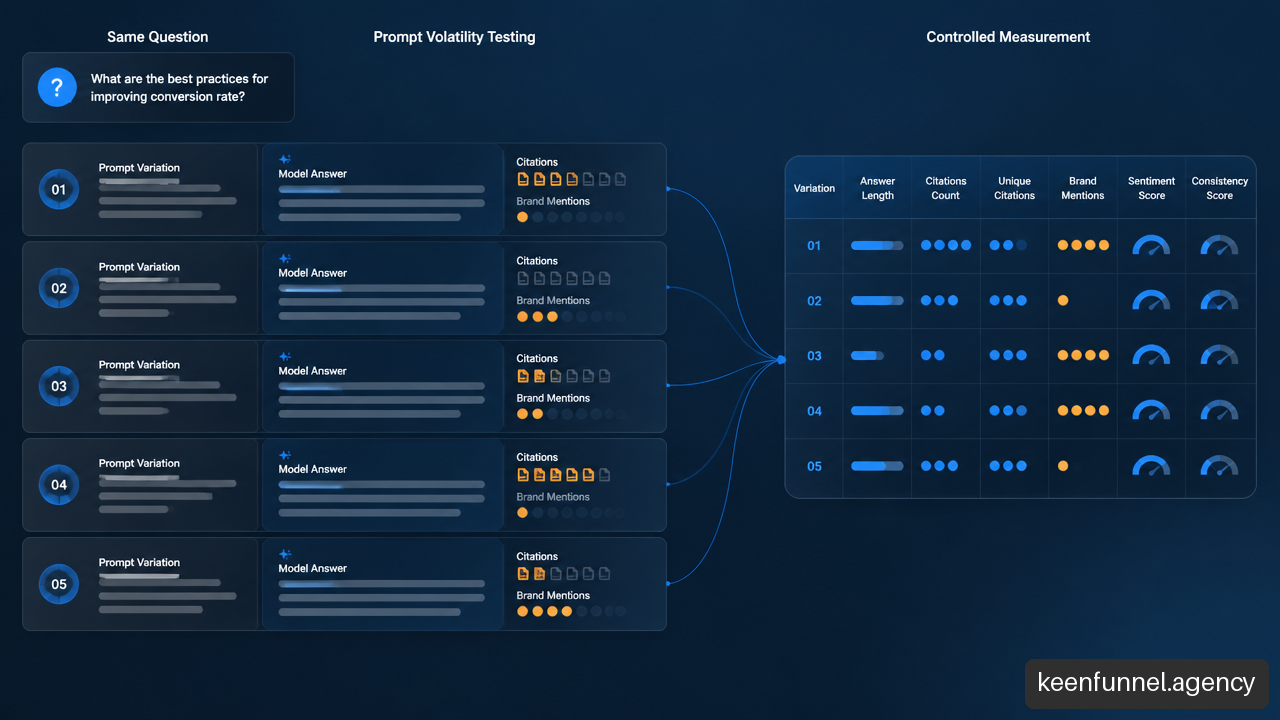
A simple volatility record can use a rate: brand appearances divided by completed tests for the same controlled prompt. If a brand appears in six of eight tests, report “appeared in 75% of observed tests under the recorded conditions,” not “owns the prompt.” The wording is less dramatic, but it is more honest and more useful for decision makers.
Score Opportunities By More Than Estimated Demand
Estimated demand can inform prioritization, but the estimate must be understood before it drives a budget. It may be based on modeled data, a platform’s dataset, a search proxy, or a blended method. It is not automatically a count of all questions submitted by real users.
A stronger priority model combines demand with business value and answer quality. We can use a five part prompt quality score:
Factor | What To Assess | When It Raises Priority |
|---|---|---|
Demand evidence | Observed frequency or clearly labeled estimate | The topic appears repeatedly in reliable sources |
Business impact | Revenue relevance, retention value, or operational cost | The answer influences a meaningful decision |
Answerability | Availability of current, verifiable evidence | The business can answer clearly without exaggeration |
Visibility gap | Competitors appear while the brand is absent or misrepresented | A credible evidence gap can be addressed |
Risk | Legal, medical, financial, safety, or reputation concerns | Lower risk supports faster publication and testing |
This model prevents a common trap: chasing a broad question with uncertain commercial value while ignoring a specific, high intent question that sales teams hear every week. It also flags prompts that should not become marketing assets. If an answer requires legal advice, unsupported performance claims, or sensitive personal data, the right response may be a carefully bounded explainer or a referral to qualified help, not aggressive optimization.
How To Turn Findings Into Better Content And Operations
Build Content Around Decision Evidence
The best response to a visibility gap is not always a new article. First identify what the answer engine and customer would need to make an accurate recommendation. That may be a clear service page, documented implementation details, transparent pricing guidance, location specific information, product documentation, structured comparisons, or an expert reviewed troubleshooting guide.
A useful content brief answers four questions:
What decision is the person trying to make?
What evidence would make the answer reliable?
Which page or asset should carry that evidence?
What claim must be avoided because it cannot be supported?
For a workflow automation provider, the topic “How can a business reduce manual lead handoffs?” should not produce vague claims about saving time. It should explain the trigger, the data handoff, the human approval point, the failure alert, and the measurable outcome the organization can track. That structure improves customer usefulness and gives answer systems more concrete material to interpret.
Connect Prompt Insights To AI Orchestration
Prompt Research also supports internal operations. Recurring questions can reveal where customer intent, product knowledge, and workflow design are disconnected. The same source tagged prompt library used for content planning can inform knowledge bases, support routing, agent instructions, and human review rules.
AI orchestration means coordinating models, agents, data workflows, business rules, and human oversight to carry out a process. Prompt insights improve orchestration when they are used as tested inputs rather than copied blindly into an autonomous system.
For instance, a recurring question about appointment availability may require more than a polished answer. It may require a system that checks approved scheduling data, respects service area rules, asks for missing information, and escalates exceptions to a person. The prompt reveals the intent. The workflow determines whether the response is safe and useful.
Use prompt findings in automation when:
• The request is common and clearly defined
• The required data is current and governed
• The workflow has explicit exception handling
• A human can review high impact decisions
Avoid autonomous handling when the request is ambiguous, emotionally sensitive, regulated, or dependent on information the system cannot verify.
Create A Measurement Loop That Leads To Action
Content publication is not the end of the process. Record the baseline, update the supporting evidence, then retest under the same conditions. Watch for changes in answer accuracy, citation quality, competitor presence, and relevant business indicators such as qualified inquiries or reduced support friction.
Prompt classification can add useful context here. Omnia’s prompt research guidance notes that prompts can be classified by intent, output type, complexity, and urgency. These dimensions help decide whether a topic needs a short answer, a comparison page, a detailed guide, a calculator, or a human assisted path.
We should avoid claiming a direct revenue effect from a visibility change unless the measurement design supports it. A more credible report might say that a revised guide increased accurate brand inclusion in repeated tests and coincided with more visits to the relevant service page. It should not claim that the guide alone caused new revenue without reliable attribution.
Key Takeaways
The Operating Principles
• Treat prompt language as evidence with a source. Separate customer observed wording from synthetic ideas.
• Measure answers independently from prompts. Discovery, answer review, and visibility tracking answer different questions.
• Test repeatedly when a decision matters. One generated response is not a stable market measurement.
• Score quality as well as presence. An accurate, relevant citation is more valuable than an unsupported name drop.
• Prioritize by business impact and answerability. Estimated demand alone can send teams toward weak opportunities.
• Use findings across content and operations. Repeated customer questions can improve pages, knowledge systems, workflow rules, and escalation paths.
Frequently Asked Questions
What Is Prompt Research?
Prompt Research is the structured study of questions submitted to generative answer systems. It includes discovering questions, clustering related wording into topics, reviewing answers, and prioritizing actions based on customer intent, business value, and evidence quality.
How Is Prompt Research Different From Keyword Research?
Keyword research focuses on terms and search behavior. Prompt Research adds the requested outcome and the generated response. It asks not only what people seek, but also what advice, brands, citations, and comparisons they receive. Keyword data can still support language discovery, especially when it reveals recurring customer vocabulary.
Which Platforms Should Be Included?
Include the platforms your customers are likely to use and the regions where you operate. Start narrow if resources are limited. A focused set of high value topics tested on the most relevant platforms is more useful than broad monitoring with no control over location, timing, or account conditions.
How Can We Tell Whether A Prompt Is Real Or Synthetic?
Record its source. Prompts from support tickets, sales notes, interviews, site search, and chat transcripts are observed evidence. Model generated variants are synthetic. Both can be useful, but only observed prompts should be treated as direct proof of customer language or frequency.
How Many Times Should We Test A Prompt?
There is no validated universal number. For important topics, test repeatedly under the same recorded conditions and look for stable patterns. If results vary widely, report volatility rather than forcing a single conclusion. For example, a recommendation that appears in one of several runs should be treated as a weak signal.
What Should We Do When Competitors Appear But We Do Not?
First inspect the answer quality. Identify the competitor pages, factual claims, citations, and decision criteria that appear to support the recommendation. Then determine whether your own site has stronger, current evidence for the same need. Improve the relevant asset rather than publishing a generic competitor page by default.
Can Prompt Research Support Regional Content Planning?
Yes. Location, language, regulations, availability, and local terminology can change what counts as a helpful answer. Maintain region specific records when the offering or customer context differs. Do not assume a prompt cluster from one country transfers cleanly to another.
Sources
Verified Sources
• semrush.com: https://www.semrush.com/features/prompt-research/
• sistrix.de: https://www.sistrix.de/ai/prompt-research
• sistrix.com: https://www.sistrix.com/blog/prompt-research/
• useomnia.com: https://www.useomnia.com/knowledge-base/prompt-research

