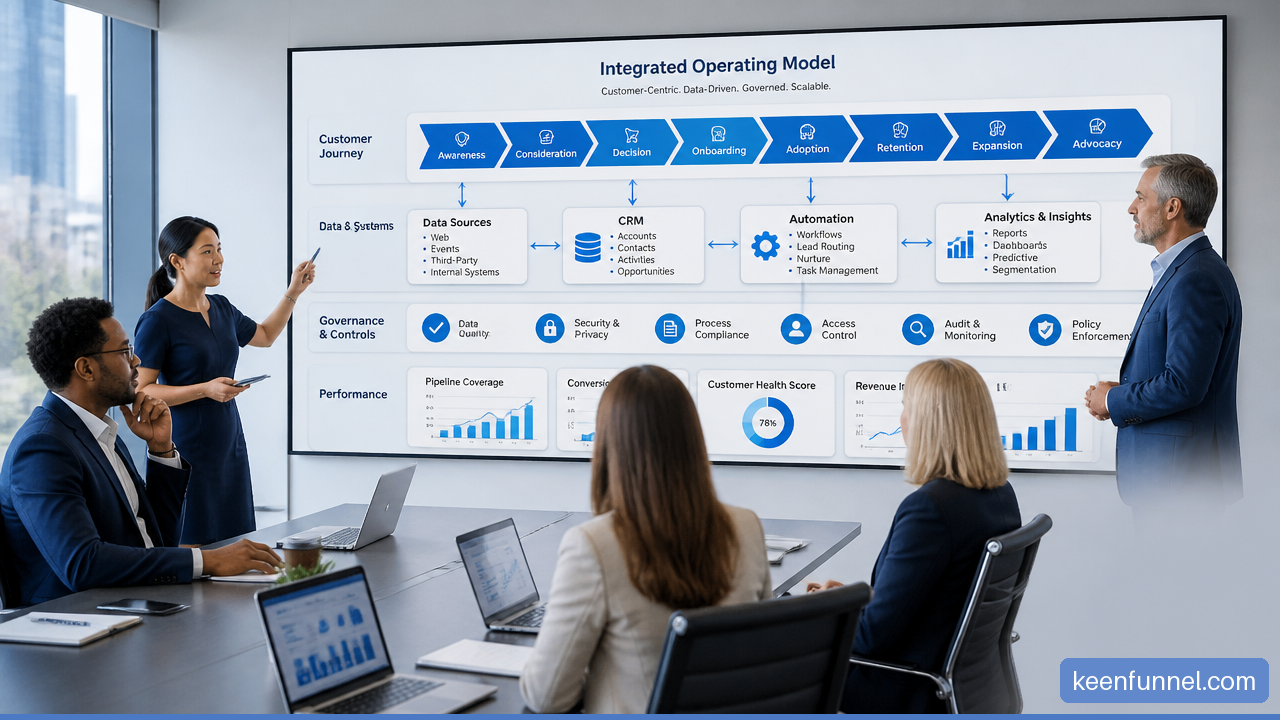
Knowing how to design a digital operating model for a growing B2B company means deciding how people, processes, data, technology, and partners will work together as complexity increases. It is not an org chart, a software stack, or a transformation plan on its own. It is the practical system that turns business strategy into repeatable execution.
For a growing B2B company, the goal is simple: create more revenue capacity and better customer service without creating a matching increase in manual work, approvals, duplicate tools, and unclear ownership. The model should help teams move faster while making performance easier to see and manage.
Table Of Contents
Start With Value Streams and Growth Constraints
A digital operating model should begin with the outcomes the company must produce, not the tools it wants to buy. Start by defining the growth problem in business terms. For example, a company may need to reduce lead response time, improve conversion from qualified opportunity to closed business, shorten implementation time, increase renewals, or lower cost to serve.
I would treat the operating model as the bridge between those outcomes and daily work. If the bridge is weak, every new product, market, seller, campaign, or customer creates more friction.
Map the End to End Value Stream
A department chart tells you where people report. A value stream shows how customer value moves through the company.
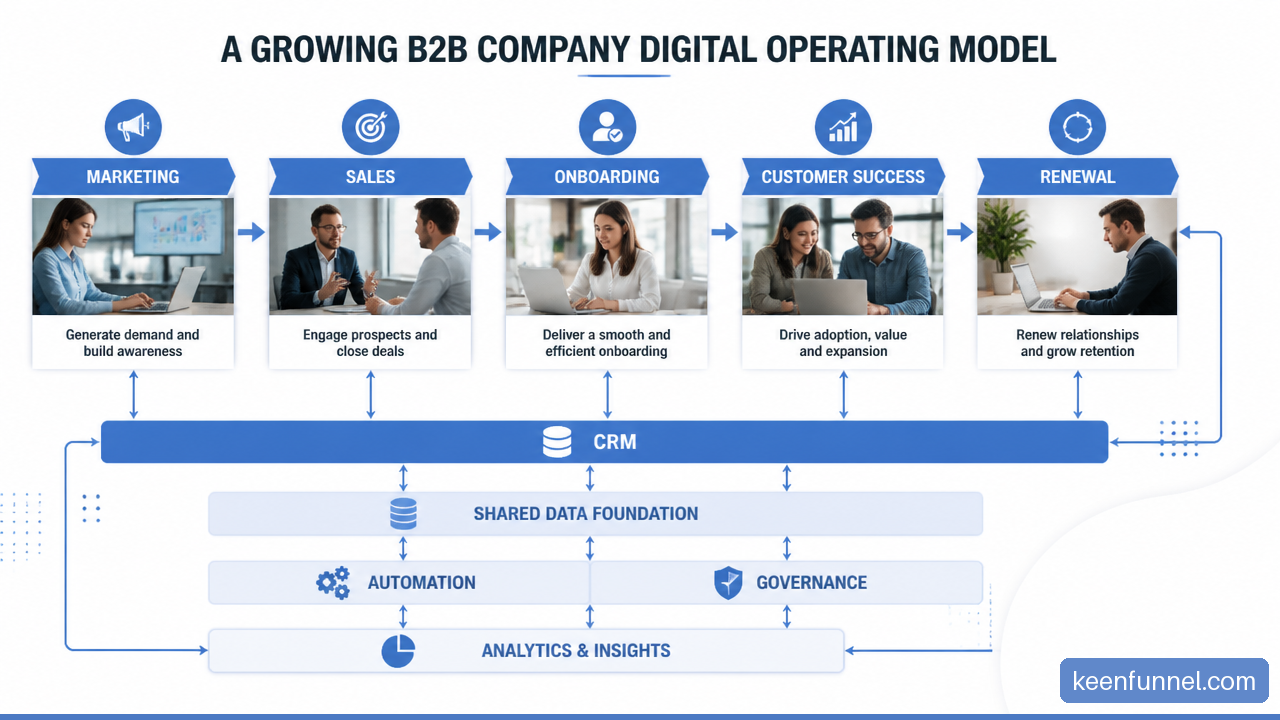
For a B2B firm, a common value stream may look like this:
Create demand through marketing, partners, referrals, or outbound sales.
Capture and qualify the account in customer relationship management (CRM).
Discover needs, build a proposal, and manage the buying process.
Contract, onboard, implement, or deliver the service.
Support adoption, renew the relationship, and identify expansion opportunities.
Map this sequence as it works now, including systems, handoffs, delays, and rework. Ask practical questions:
• Where does customer data get entered more than once?
• Where do prospects wait for an internal response?
• Which handoffs depend on a spreadsheet, inbox, or informal meeting?
• Which teams cannot see the same account status?
• Which decisions require executive approval when they should not?
A growing B2B software business, for instance, may find that marketing can generate demand quickly, but sales qualification varies by rep. Customer success then receives incomplete implementation details after the deal closes. The visible problem is slow onboarding. The deeper operating problem is that qualification, sales, and delivery use different definitions of customer readiness.
Design around the flow of value to the customer. Departments still matter, but they should not become walls that data, decisions, and work cannot cross.
Forrester’s view of B2B customer obsessed growth supports this logic: processes, workflows, and metrics should align around customer value rather than internal silos. That is the central implication of a cross functional customer experience operating model with coordinated management routines and incentives.
Identify the Signals That the Current Model Is Failing
There is no universal employee count or revenue threshold that automatically requires an operating model redesign. The better trigger is operational strain. Review the model when several of these signals appear at once:
Growth Signal | What It Usually Means | Design Response |
|---|---|---|
Sales, marketing, and delivery report different numbers | Definitions and data ownership are inconsistent | Create shared lifecycle definitions and a governed reporting layer |
Approval queues delay campaigns, pricing, or product changes | Decision rights have not kept up with growth | Delegate routine decisions with clear guardrails |
Delivery backlogs grow faster than customer demand | Capacity, prioritization, or intake is unclear | Standardize intake and rank work by business value |
Teams adopt overlapping software | Technology purchasing is disconnected from process design | Establish platform governance and application ownership |
Leaders become the default escalation point | Span of control and accountability are under strain | Clarify accountable owners and escalation paths |
Do not redesign everything because one metric has a bad month. A redesign is justified when recurring friction limits customer value, speed, or control. For example, one missed sales forecast may be a data quality issue. Repeated forecast disputes across regions, products, and customer segments usually point to a structural problem.
Define Design Principles Before Choosing Structure
Design principles prevent the target model from becoming a negotiation between departments. Keep them specific enough to guide tradeoffs.
A growing B2B company might adopt principles such as:
• Standardize core customer and revenue processes before allowing local customization.
• Maintain one accountable owner for each customer facing process.
• Put shared customer, product, and financial data under defined governance.
• Automate repeatable work only after the process is stable and measurable.
• Keep decisions close to the work unless risk, investment, or architecture requires escalation.
This sequencing matters. Automating a broken lead routing process simply distributes bad leads faster. Building a complex data platform before agreeing on account stages, ownership, and reporting definitions creates a more expensive version of the same confusion.
Key Takeaways
• Start with growth outcomes and customer value streams, not a preferred platform or team structure.
• Use recurring operational signals, such as cycle time slippage and duplicate tools, to decide when the model needs redesign.
• Standardize the core before expanding customization, automation, or regional variation.
• Give every critical decision, metric, system, and handoff an explicit owner.
Design the Core Components of the Model
A complete digital operating model links organization, governance, process, sourcing, technology, data, and culture. Implement Consulting Group’s operating model design approach similarly frames the work as translating strategy into concrete structures, capabilities, ways of working, and decision mechanisms.
The components are connected. A CRM redesign without data ownership fails when teams disagree about who may change account records. A new revenue operations role cannot succeed if sales leaders can bypass the qualification process. Technology is an enabler, not the model itself.
Build a Capability Map Before Selecting Tools
A capability map identifies what the company must be able to do, regardless of who does it or which system supports it. It helps leaders separate genuine capability gaps from tool requests.
For a growth focused B2B business, the map often includes:
• Demand generation and account targeting.
• Lead and account qualification.
• Pipeline management and forecasting.
• Proposal, pricing, and contract operations.
• Customer onboarding and service delivery.
• Customer success, renewal, and expansion management.
• Data integration, reporting, security, and platform administration.
• Process automation and continuous improvement.
For each capability, document four things: desired outcome, accountable owner, process maturity, and supporting data or systems. If a capability has no owner, it will often become a hidden burden shared across several teams.
Choose What to Build, Buy, or Partner For
Growing companies rarely need to internalize every capability. The right sourcing model depends on whether the capability creates differentiation, needs deep company knowledge, changes frequently, or carries material operational risk.
Option | Choose It When | Avoid It When |
|---|---|---|
Build internally | The capability is central to differentiation, customer experience, or proprietary workflow | The company lacks the sustained capacity to maintain it |
Buy a platform | Requirements are common, mature, and supported by reliable software | The process is still unclear or heavily dependent on custom workarounds |
Partner externally | Specialist skills, temporary capacity, or independent execution are needed | The partner owns critical knowledge without documentation or internal oversight |
A practical rule is to keep strategic process ownership internal, even when delivery is outsourced. A company can work with an implementation partner for CRM automation, for example, while retaining ownership of lifecycle definitions, data standards, approval rules, and acceptance criteria.
Deloitte identifies five operating choices involving primary digital ownership, reporting structure, organizational models, gap closure, and team capabilities. Those choices provide a useful frame for evaluating digital ownership and capability choices rather than treating digital as one isolated function.
Create a Shared Data Contract
A shared data contract is a simple but disciplined agreement about the data used to run the business. It should define common entities, lifecycle stages, required fields, system of record, quality rules, access rights, and reporting logic.
At minimum, document ownership for accounts, contacts, opportunities, products, pricing, contracts, support cases, and customer health indicators. For each item, define who creates it, who can change it, how duplicates are handled, and which system is authoritative.
This is especially important when marketing automation, CRM, finance, support, and delivery platforms exchange data. Without a contract, integration can spread conflicting records across more systems. With one, data integration becomes a controlled process that improves reporting and customer experiences.
Set Decision Rights, Governance, and Operating Cadences
Governance should not mean more meetings. It should mean fewer stalled decisions, fewer duplicated initiatives, and clearer accountability.
The most useful governance design separates decisions by type. A functional RACI can show who is responsible for a task, but it often misses the real issue: different decisions require different authorities.
Use a Decision Rights Map by Decision Type
Create a decision rights map for recurring choices that affect growth, customers, risk, and investment.
Decision Type | Accountable Decision Owner | Required Input | Escalate When |
|---|---|---|---|
Product or service priority | Product or business owner | Sales, customer success, delivery, finance | Investment or customer impact crosses agreed limits |
Pricing and commercial exceptions | Revenue leader | Finance, legal, delivery | Margin, risk, or contract terms exceed guardrails |
CRM process changes | Revenue operations owner | Sales, marketing, customer success, IT | Change affects shared data model or core integrations |
Architecture and security standards | Technology owner | Security, process owners, vendors | Risk, cost, or compliance impact is material |
Vendor selection and renewal | Business capability owner | Procurement, technology, finance | Contract creates platform dependency or major spend |
The exact roles vary by company. The principle does not: the person closest to the work should make routine decisions within clear limits, while leadership focuses on strategic tradeoffs and exceptions.
A frequent failure mode is “digital as a sidecar.” In this model, a small digital team is expected to improve customer experience but cannot change sales process, data definitions, budgets, or delivery priorities. The remedy is not necessarily a larger central team. It is formal authority for the decisions that team is expected to influence.
Run Separate but Connected Operating Cadences
B2B companies need different rhythms for commercial execution, product or service improvement, and delivery. Combining them into one broad status meeting tends to obscure decisions.
A workable cadence may include:
Weekly commercial review: pipeline coverage, lead quality, response time, conversion, forecast risk, and account movement.
Biweekly delivery review: onboarding capacity, implementation milestones, blockers, support trends, and cost to serve.
Monthly product and platform review: roadmap priorities, automation backlog, data quality, architecture changes, and vendor performance.
Quarterly operating model review: capabilities, process exceptions, investment priorities, staffing, and governance effectiveness.
Each forum needs a defined input, a decision list, and an owner for follow through. If the meeting only reports activity, it is not governance.
McKinsey describes a next generation operating model for digital value creation that coordinates discovery, design, delivery, and de risking across partners. That supports a coordinated discover, design, deliver, and de risk approach rather than treating implementation as a handoff from strategy to IT.
Measure Revenue Quality and Service Efficiency Together
Do not measure digital work only by traffic, tickets closed, or number of automations launched. Those indicators can rise while commercial performance falls.
Use a balanced metric set:
• Acquisition: account engagement, lead response time, qualification rate, and cost per qualified opportunity.
• Conversion: pipeline velocity, stage conversion, sales cycle length, discount rate, and forecast accuracy.
• Delivery: onboarding time, implementation completion rate, rework, support volume, and cost to serve.
• Retention: adoption, renewal rate, expansion rate, customer health, and unresolved issue aging.
• Operating health: data completeness, automation failure rate, backlog age, process compliance, and vendor service levels.
Metrics should have one owner and a defined action when performance moves outside an agreed range. A dashboard without an operating response is visibility, not management.
Implement, Test, and Scale the Model
A target operating model is useful only when it changes how work happens. Treat implementation as a sequence of controlled experiments, not a single organization wide launch.
Pilot One High Value Stream
Choose a pilot where the business outcome is clear, the process crosses functions, and leaders can remove blockers. Lead to opportunity conversion, onboarding, or renewal operations are often suitable candidates.
A valid pilot should include:
• A baseline metric, such as current response time or onboarding duration.
• A documented current process and target process.
• Named process owner, data owner, and technology owner.
• A limited customer segment, product line, or region.
• Predefined success criteria and stop criteria.
For example, a company could pilot a revised inbound lead process for one market. Marketing, sales, and revenue operations agree on qualification rules. The CRM routes qualifying leads automatically, managers review exceptions weekly, and the company measures response time, acceptance rate, and opportunity conversion for eight weeks. If data quality worsens or conversion does not improve, the team should diagnose the cause before extending the design.
Govern Platforms and External Partners
External partners can accelerate implementation, but they can also create dependency when they hold system knowledge, process logic, or administrative access without clear controls.
Set platform governance early:
• Maintain a current application inventory with business owner, technical owner, cost, contract date, data classification, and integration dependencies.
• Require documented configuration, automation logic, data flows, and access controls from every partner.
• Use acceptance criteria before work is considered complete, including documentation and internal handover.
• Review vendor performance against delivery quality, support responsiveness, security obligations, and business outcomes.
• Avoid allowing individual teams to purchase tools that duplicate governed capabilities without a review.
Fair warning: excessive central control creates its own delays. The goal is not to force every software request through a committee. It is to centralize standards for shared platforms, data, security, and architecture while allowing teams to make low risk local choices.
Scale Through Feedback Loops, Not Bureaucracy
After the pilot, scale only what is stable. Standardize the workflow, role definitions, reporting logic, and training materials before extending it to another segment or geography.
Keep a feedback loop at three levels:
Frontline teams report exceptions and workarounds.
Process owners analyze root causes and prioritize fixes.
Governance leaders decide whether to adjust standards, funding, systems, or decision rights.
If adoption is weak, do not assume resistance is the problem. The process may add steps without reducing work, the automation may handle edge cases poorly, or managers may be rewarding old behavior. Recovery starts by checking the actual workflow and the incentives around it.
Frequently Asked Questions
What Is a Digital Operating Model for a Growing B2B Company?
It is the practical design for how a company delivers digital strategy through people, processes, data, technology, governance, and partners. It defines how work moves from demand generation through sales, delivery, service, and renewal, including who owns decisions and performance.
How Is a Digital Operating Model Different From a Strategy or Org Chart?
Strategy defines where the company intends to compete and grow. An org chart shows reporting lines. A digital operating model explains how cross functional work gets done, how priorities are selected, how systems share data, and who can make which decisions.
What Should a Growing B2B Company Standardize First?
Standardize core lifecycle definitions, customer and account data, lead routing, pipeline stages, pricing approvals, delivery intake, and baseline reporting. These processes affect multiple teams and become costly when every group uses a different version.
How Should Product, Sales, Marketing, and IT Work Together?
They should share value stream outcomes and clear handoffs. Marketing should understand qualification rules. Sales should capture information delivery needs. Product or service teams should use customer feedback in priorities. IT should govern architecture, integration, access, and risk without becoming the owner of every business decision.
How Do You Decide Whether to Build, Buy, or Outsource a Capability?
Build capabilities that create meaningful differentiation and require deep internal knowledge. Buy mature capabilities that are common across businesses. Partner for specialist work, temporary capacity, or implementation support. Retain internal ownership of strategy, process standards, data rules, and critical platform knowledge in every case.
What Governance Structure Works Best for a Scaling B2B Business?
A hybrid model is often practical: a small central enablement group governs shared data, platforms, standards, and measurement, while commercial and delivery teams own execution within defined guardrails. The best structure depends on complexity, regulatory exposure, and how much local variation the business genuinely needs.
When Should a Company Redesign Its Operating Model?
Redesign when recurring friction affects growth or customer value. Typical signs include growing approval bottlenecks, unreliable forecasts, duplicate software, unclear handoffs, recurring customer onboarding issues, and leaders spending too much time resolving operational exceptions.
Sources And References
• Deloitte Insights — Digital operating models
• Implement Consulting Group — Designing a future-fit digital operating model
• McKinsey — Introducing the next-generation operating model