A digital operating model framework for small and midsized businesses gives people a shared way to decide, deliver, measure, and improve digital work. It is not a software shopping list or a new org chart. It is the minimum set of rules that connects customer needs, workflows, data, technology, ownership, and decisions.

For an SMB, the goal is not to copy a large enterprise transformation program. I recommend building a model that is small enough to run with existing staff, but structured enough to reduce manual work, unclear handoffs, duplicate tools, and founder bottlenecks. A good model makes it easier to scale without creating a new layer of confusion.
Table Of Contents
• Key Takeaways
• Build The Minimum Viable Digital Operating Model
• Design Ownership, Governance, And Rollout
• FAQ Section
• Sources And References
Key Takeaways
• A digital operating model defines how digital value is delivered, including decision rights, workflows, data ownership, tools, and performance measures.
• SMBs should start with one priority customer journey or value stream, such as lead to sale, onboarding to renewal, or service request to resolution.
• Centralize standards that need consistency, such as CRM data rules, security controls, automation standards, and vendor management. Keep customer facing decisions close to the teams doing the work.
• Use a small KPI set. Lead time, adoption, rework rate, customer task completion, and commercial conversion are often more useful than a crowded dashboard.
• Separate strategic governance from delivery governance. Leadership should not need to attend every workflow review.
• A pilot is usually safer than a full redesign when staff capacity is limited, processes are unclear, or the business has several disconnected systems.
A good enough SMB operating model is one that people can actually follow every week. It should create clearer decisions and better execution, not more meetings or documentation.
Build The Minimum Viable Digital Operating Model
Start With The Business Outcome, Not The Technology
A digital operating model explains how an organization creates value and who is responsible for doing so. Deloitte describes digital operating model design as a way to connect value creation with roles, governance, incentives, and KPIs that enable faster decisions. Its guidance on digital operating models and transformation governance is useful because it places operating decisions ahead of technology choices.
For an SMB, the first question is simple: Which business outcome needs more control or speed? Choose one outcome that matters commercially or operationally. Typical starting points include:
• Increasing the percentage of qualified leads that receive a timely follow up
• Reducing the time needed to create and approve a customer proposal
• Improving onboarding completion and reducing early customer churn
• Reducing support response delays and repeated service work
• Improving visibility from marketing spend to revenue outcomes
Avoid starting with “we need AI” or “we need a better CRM.” Those may become valid solutions, but they do not define the operating problem. If a sales team misses follow ups because inquiry data is spread across forms, inboxes, spreadsheets, and a CRM, the problem is not just software. It is unclear ownership of intake, routing, qualification, and escalation.
I suggest writing the intended outcome in one sentence: “We will reduce the time from a qualified inquiry to first sales contact while keeping lead status accurate in one system.” This statement sets a boundary. It tells the team what is in scope and what can wait.
Choose One Primary Design Unit
A common source of delay is trying to organize everything around too many concepts at once. Teams may debate whether their model should be based on products, departments, customer journeys, platforms, or capabilities. Each can be useful, but an SMB usually needs one primary design unit.
Primary Design Unit | Best Fit | What It Clarifies | When To Avoid Making It Primary |
|---|---|---|---|
Customer journey | Service firms, agencies, B2B sellers, customer success teams | Handoffs from customer need to outcome | When internal operations are the immediate constraint |
Value stream | Businesses with repeatable end to end delivery | Work flow, bottlenecks, timing, and waste | When work is highly bespoke and varies widely |
Product or service line | SaaS firms, product businesses, packaged services | Commercial accountability and roadmap choices | When shared systems are more urgent than product ownership |
Business capability | Growing firms with several channels or units | Long term ownership of functions such as analytics or billing | When the team needs a quick operational pilot |
Umbrex notes that a digital operating model can use customer journeys, digital products, platforms, capabilities, or value streams as its unit of analysis. Its digital operating model framework also frames design as a series of choices about scope, current state, future state, tradeoffs, and implementation.
For many SMBs, I would start with a customer journey or value stream because it exposes the real handoffs. Consider a professional services company that wants faster proposal turnaround. The journey may begin with a website inquiry and end when a signed proposal enters project setup. Mapping it can reveal that marketing owns form capture, sales owns qualification, finance owns pricing approvals, and operations owns staffing checks. If none of those owners share a standard workflow, speed will remain inconsistent even after a new automation tool is added.
The other design units still matter. Use them as secondary views. The proposal journey may rely on the “revenue operations” capability, use a CRM platform, and support a particular service line. But only one view should govern the first pilot.
Define The Six Components That Make The Model Work
A practical framework does not need dozens of workstreams. I recommend documenting six components for the chosen value stream.
Customer outcome
Define the result the customer should receive and the business result you want to improve. This could be a faster response, fewer onboarding steps, an accurate invoice, or a resolved service issue.
Workflow and service level
Show the stages of work, handoffs, required inputs, and target response times. Include exceptions. For example, a lead with incomplete information may go to a nurture process rather than directly to sales.
Roles and decision rights
Name one accountable owner for the outcome, not merely a department. Then identify who performs work, who approves changes, and who must be informed.
Data and systems
Specify the system of record for key fields and the approved path for data movement. A CRM may own customer and deal records, while an accounting system owns invoice status. Spreadsheets may still be useful, but they should not silently become the source of truth.
Governance and controls
Set the decisions, meeting rhythm, privacy rules, access levels, vendor responsibilities, and escalation path. This is where unmanaged automation risk is reduced.
Measures and improvement loop
Establish a few metrics, review them on a set cadence, and decide how approved changes will be tested before wider release.
This approach matches the broader view in Gartner’s midsize data and analytics operating model guidance, which treats an operating model as the combination of resources, processes, structures, architectures, and delivery model needed to execute strategy.
The practical implication is important: do not assign data, systems, and process work to separate initiatives that never meet. A lead routing automation will fail if data definitions are unclear. A dashboard will mislead if ownership is unclear. A new CRM will become shelfware if daily workflow remains outside it.
Design Ownership, Governance, And Rollout
Decide What To Centralize And What To Leave With Teams
SMBs need consistency, but overcentralization can slow customer work. The most useful decision rule is this: centralize what must be consistent, reusable, secure, or measurable; decentralize what requires local customer judgment.
Centralize Across The Business | Keep Close To The Business Team |
|---|---|
Core data definitions and system records | Customer conversations and account context |
Identity, access, privacy, and security rules | Daily prioritization within an active customer queue |
CRM administration and automation standards | Tailored service delivery decisions within approved limits |
Vendor contracts, integration documentation, and renewal controls | Channel specific messaging and campaign execution |
Reporting definitions and KPI calculation | Fast operational fixes that do not change shared systems |
A service led business often benefits from a small shared operations backbone: CRM administration, analytics, finance integration, and automation standards can sit with one operations owner or a small cross functional group. Delivery teams should still control the customer conversations and work priorities that require context.
A product led business may need stronger product ownership. Product, engineering, support, and marketing should agree on the customer problem, release priorities, adoption signals, and support feedback loop. A channel led business, such as a distributor or commerce company, may place more emphasis on inventory data, order flow, partner information, and marketing attribution.
There is no universal split. The tradeoff depends on speed, cost, customer responsiveness, risk, and available skills. Fair warning: centralizing every request under a founder, COO, or IT generalist may feel controlled at first, but it creates a queue that slows the business. On the other hand, allowing each team to choose its own forms, dashboards, and automation tools creates data fragmentation that is expensive to repair later.
Separate Strategic Governance From Delivery Governance
Governance should answer two different questions: Are we investing in the right work? and Is the work being delivered safely and well? Combining both questions in one long meeting is a reliable way to create meeting overload.
I recommend two lightweight cadences:
Monthly strategic review
Participants: executive sponsor, operating owner, finance or commercial lead, and any relevant functional leader.
Decisions: priorities, budget, vendor commitments, policy exceptions, expected outcomes, and whether a pilot should expand, pause, or stop.
Weekly delivery review
Participants: value stream owner, process owner, system owner, and the people responsible for delivery.
Decisions: blockers, data issues, testing status, workflow changes, adoption gaps, and customer impact.
Use a one page decision register. For each material decision, record the decision, accountable person, date, reason, affected systems, and follow up measure. This creates a useful audit trail without turning a small company into a bureaucracy.
Staffing also needs an explicit target state. Gartner’s IT operating model assessment for midsize enterprises supports assessing current IT operations and staffing distribution against the desired future state. For an SMB, this does not automatically mean hiring a large internal technology team. It may mean deciding which work must remain internal, such as process ownership and data approval, and which work can be handled by a specialist partner.
Vendor governance matters because external providers often configure systems, build automations, manage campaigns, or maintain integrations. Every vendor should have a named internal owner. That owner should know what data the vendor can access, what outcomes they are responsible for, how changes are approved, how documentation is stored, and what happens if the engagement ends.
Roll Out Through A Controlled Pilot
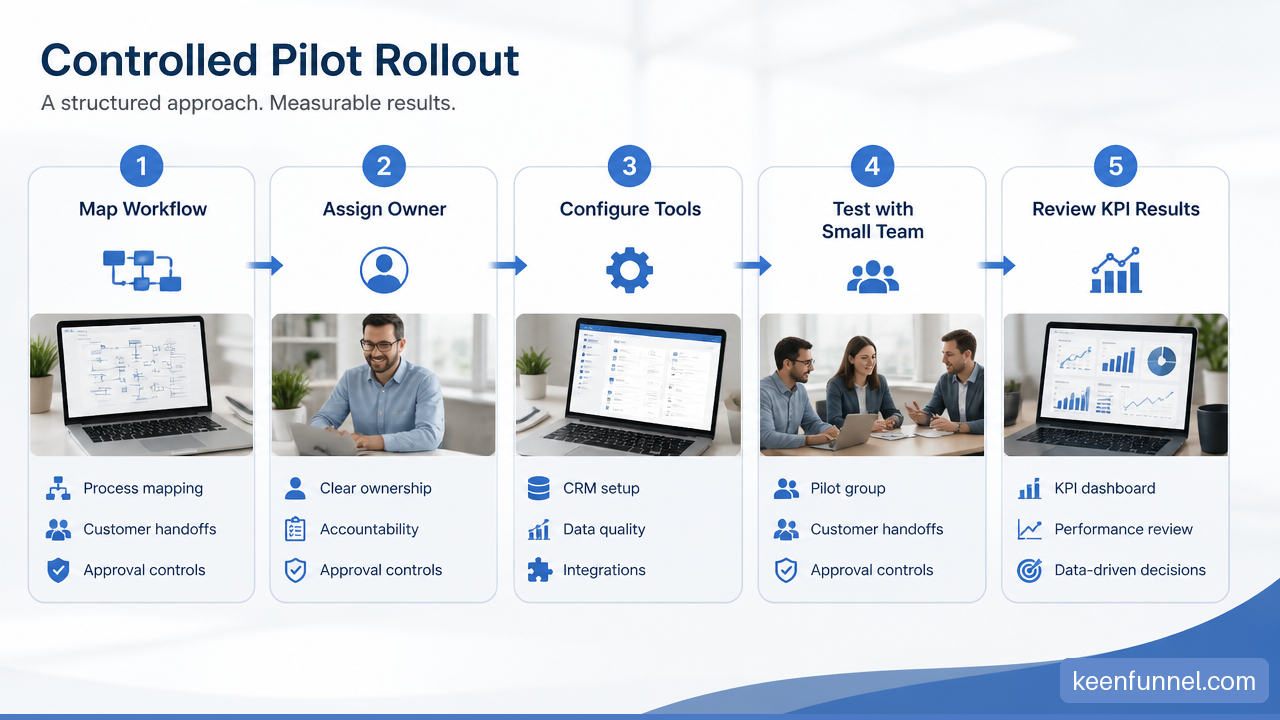
A full company redesign is appropriate only when the business is already making a major structural shift, such as a merger, a platform replacement, or a new operating unit. For most SMBs, a pilot offers a clearer path: prove a workflow, measure results, document standards, then expand.
A value oriented sequence is supported by Implement Consulting Group’s approach to defining, testing, implementing, monitoring, and iterating an operating model. The order matters. Testing before broad implementation limits the cost of a bad assumption.
Use this rollout sequence:
Select one high friction value stream. Choose work with a visible pain point and a measurable outcome. Lead response, customer onboarding, appointment scheduling, proposal approval, and support triage are common candidates.
Map the current workflow. Record each handoff, system, manual task, approval, exception, and delay. Do not map an ideal process from memory. Map what actually happens.
Set the future workflow and owner. Remove unnecessary steps, establish a system of record, define data requirements, and give one person accountability for the outcome.
Configure and test in a limited group. Use a small team, selected region, service line, or customer segment. Test normal cases and exceptions, including missing data, duplicate records, failed automations, and staff absence.
Review the scorecard. Expand only when adoption is stable and the outcome improves without creating unacceptable risk or rework.
A minimal scorecard can include:
• Lead time: How long work takes from trigger to completion
• Adoption: Whether people use the intended system and workflow
• Defect or rework rate: How often work must be corrected, repeated, or manually repaired
• Customer task completion: Whether customers finish the intended action, such as booking, onboarding, payment, or document submission
• Commercial result: Conversion, retention, cost to serve, or revenue quality where the value stream directly affects it
Be cautious with metrics that look precise but do not drive a decision. For example, counting automation runs does not prove that an onboarding process improved. A better question is whether new customers complete required setup steps faster and need fewer support interventions.
Recovery should be planned before rollout. If an automation assigns records incorrectly, have a manual queue, clear rollback steps, and an owner who can correct the data. If a new dashboard conflicts with finance reporting, pause broad use until the calculation logic is reconciled. Controlled recovery is part of operational maturity, not a sign of failure.
FAQ Section
Common Questions About Digital Operating Models
What Is A Digital Operating Model For A Small Or Midsized Business?
It is a practical framework for organizing digital work around business outcomes. It defines workflows, roles, data, systems, decision rights, governance, and KPIs. For an SMB, it should be lean enough to operate with limited staff and focused enough to solve a real business constraint.
How Is A Digital Operating Model Different From An Org Chart Or IT Strategy?
An org chart shows reporting lines. An IT strategy describes technology direction and investment priorities. A digital operating model explains how people, processes, data, and technology work together every day to deliver an outcome. It identifies who owns a workflow, who approves changes, and how performance is measured.
What Decisions Should Be In Scope First?
Start with decisions that affect a high value customer journey or recurring operational bottleneck. Usually, that includes workflow ownership, the system of record, data rules, response standards, exception handling, and the KPI set. Leave broad structural changes and large platform replacements out of the first pilot unless they are unavoidable.
How Do You Design A Model With Limited Staff?
Use a minimum viable design. Assign one accountable owner for each priority value stream, establish a small set of shared standards, and use SaaS tools where they fit rather than building custom platforms too early. External specialists can help with implementation, but internal leaders should retain ownership of priorities, process decisions, and data access.
What Should Be Centralized In An SMB?
Centralize items that need consistency or risk control, including data definitions, CRM rules, access permissions, vendor governance, reporting calculations, and automation standards. Keep customer specific decisions and daily delivery priorities with the teams closest to the work. The right balance depends on how much variation the business needs to serve customers well.
Which KPIs Matter Most?
Choose metrics that show speed, adoption, quality, customer progress, and commercial impact. A small set is better than a dashboard with dozens of measures. For example, a lead management pilot could track first response time, percentage of leads assigned correctly, CRM completion rate, rework caused by bad data, and qualified lead conversion.
When Should A Midsized Business Use A Pilot Instead Of A Full Redesign?
Use a pilot when the business has limited capacity, unclear processes, uncertain technology requirements, or a need to show value before expanding. Consider a full redesign when a major event already requires coordinated change across many functions, such as a merger, an enterprise system replacement, or a new business model. Even then, phased implementation is usually easier to govern.
How Do Vendors And Outside Implementers Fit Into The Model?
Vendors can build, configure, or maintain parts of the system, but they should not become the unrecorded owner of core business knowledge. Give each vendor an internal sponsor, document their access and responsibilities, require change approval, and maintain process and integration documentation that the business can access independently.
Sources And References
• MIT Center for Information Systems Research — The Digital Operating Model: Building a Componentized Organizationhttps://cisr.mit.edu/publication/2020_0601_BuildingComponentizedOrganization_RossBeathNelson
• Gartner — A Practical Data and Analytics Strategy and Operating Model for Midsize Enterpriseshttps://emt.gartnerweb.com/ngw/globalassets/en/information-technology/documents/insights/743027-a-practical-data-and-analytics-strategy-and-operating-model-for-midsize-enterprises.pdf
• Gartner — IT Operating Model Assessment for Midsize Enterpriseshttps://www.gartner.com/en/chief-information-officer/research/it-operating-model-assessment-for-midsize-enterprises
• Deloitte Insights — Digital operating modelshttps://www.deloitte.com/us/en/insights/topics/business-strategy-growth/digital-operating-models.html
• Implement Consulting Group — The Value-Oriented Digital Operating Modelhttps://implementconsultinggroup.com/tool/the-value-oriented-digital-operating-model