


Data privacy protection and cookie consent are not solved by placing a banner on a website. They require a connected operating model: knowing what technologies collect data, preventing nonessential tracking before permission, recording choices, and honoring a changed mind later.
Cookie Consent Is A Technical Control, Not Just A Notice
A privacy policy explains an organization’s data practices. Cookie consent controls whether certain device storage, tracking scripts, pixels, and embedded services can run. Both matter, but they perform different jobs.
A visible banner can create a false sense of security if advertising tags or analytics requests fire before a visitor makes a choice. The practical standard is simple: if a technology needs consent, it should not store or access information on the device, or send related tracking requests, before that consent exists.
Purpose Matters More Than A Vendor Label
We should classify cookies and similar technologies by what they actually do, not by a supplier’s category. A vendor may describe a cookie as “essential,” but it is only likely to qualify as strictly necessary when it is needed to provide communication or a service the visitor explicitly requested.
For example, a session cookie that preserves items in a shopping cart may be necessary for checkout. A cookie that records a visitor’s browsing behavior to refine future advertising is not necessary for that checkout. The same platform can use both types of technology, which is why each use needs separate review.
Privacy Operations Need Evidence
A durable program connects four records:
• A technology inventory showing what runs on each site or app surface
• A purpose map that explains why each technology exists and who receives data
• A consent log that preserves the user choice and notice version
• A testing record showing that nonessential technology is actually blocked before consent
This structure supports clearer decisions when marketing tools, embedded media, analytics, and website changes are introduced.
Understand Privacy Rules Before Configuring Technology
GDPR, ePrivacy Rules, PECR, And CCPA Do Different Jobs
The European Union’s GDPR governs personal data processing. The ePrivacy framework addresses, among other things, storing or accessing information on a user’s device. Cookie use can trigger both sets of obligations. In the United Kingdom, PECR contains the core rules for cookies and similar technologies, while UK GDPR may apply when related personal data processing occurs.
The key point is that cookie consent is not simply a GDPR issue. In European and UK contexts, device access can require consent even where a particular identifier does not obviously contain a person’s name or email address. The Irish Data Protection Commission explains that consent can be required when information is stored on or accessed from a device, even if the technology does not contain personal data.
In the United States, laws vary by state and by business activity. The California Consumer Privacy Act, as amended by the California Privacy Rights Act, focuses heavily on notice, access, deletion, and opt out rights related to the sale or sharing of personal information. It does not create a universal United States cookie rule equivalent to the European prior consent model.
Framework | Main Practical Question | Typical Website Control |
|---|---|---|
GDPR and UK GDPR | Is personal data processing lawful, transparent, and limited? | Lawful basis, privacy notice, data rights workflow |
EU ePrivacy framework and UK PECR | Can the site store or access device information? | Prior consent where required, cookie controls |
California privacy law | Are disclosures and opt out rights available where required? | Privacy notice, preference links, rights request process |
A single banner configuration cannot determine legal applicability worldwide. We need geography, audience, business activities, vendors, and data flows assessed separately. A site serving visitors in the EU, United Kingdom, and California may need shared technical controls but different notices, links, and rights mechanisms.
Necessary Is A Narrow Service Test
Some cookies may be exempt from consent when they are strictly necessary to transmit a communication or provide an online service the person specifically asked for. Your Europe notes that websites generally need consent before cookies are installed, while narrowly defined necessary cookies may be exempt under the relevant framework: prior consent is generally required before cookies are placed, subject to limited necessary cookie exemptions.
Useful examples can include authentication, security controls, load balancing, language settings explicitly selected by the user, and a shopping basket. Context decides the outcome.
Consider a fraud detection cookie. If it protects payment processing during a purchase, it may have a strong necessary case. If the same identifier follows visitors across unrelated sites to build a risk score, that case becomes much weaker. Document the service requested, the technical function, the data involved, and what would break if the technology were disabled.
Consent Must Be Meaningful
Consent should be freely given, specific, informed, and expressed through a clear affirmative action. Silence, inactivity, or a statement that continued browsing equals agreement does not provide the same clarity.
The UK Information Commissioner’s Office states that organizations must explain cookie use and purposes and obtain consent where required. Its guidance on cookies and similar technologies also distinguishes necessary functions from nonessential activity.
A consent interface is only credible when the visitor can understand the choice and the website can technically honor it.
Build A Consent System From A Real Technology Inventory
Start With Discovery, Not The Banner
Before configuring categories, create a technology inventory. Cookie scanners are useful starting points, but they are not complete evidence. Dynamic tags may load only after a click, an error condition, a logged in session, a location selection, or a campaign parameter. Server side tracking can also obscure what occurs beyond the browser.
Review the site as a visitor would. Test key templates, including the home page, product pages, checkout, account areas, forms, embedded video pages, chat widgets, maps, and social content. Then inspect tag manager settings, source code, vendor documentation, content management system plugins, and application integrations.
Use A Record That Supports Decisions
A practical inventory should include more than cookie names. Each row should show enough context to decide whether the technology can load before consent and what happens when consent changes.
Inventory Field | Why It Matters | Example |
|---|---|---|
Technology and provider | Identifies the code or service responsible | Analytics platform, chat provider, video host |
Purpose | Connects the tool to a legitimate business function | Security, audience measurement, advertising |
Storage or request type | Shows how tracking occurs | Cookie, local storage, pixel, script request |
Domain and duration | Explains scope and persistence | First party domain, 30 day expiry |
Data recipients and transfers | Supports clear third party disclosure | Provider, advertising partner, hosting region |
Consent status | Defines whether it is blocked, exempt, or optional | Necessary, analytics, marketing, social media |
Withdrawal action | Defines the cleanup or suppression process | Delete cookie, disable tag, revoke vendor state |
A cookie policy should translate this record into plain language. Users need to understand the purpose and relevant recipients, not decode a list of technical names. Where third parties receive information, disclose their role and the practical reason they are involved.
Treat Embedded Content As A Vendor Integration
An embedded map, video player, social feed, scheduling widget, or chat tool can create device access or third party requests before the visitor interacts with it. Do not assume an embed is harmless because it appears inside your own page.
A safer pattern is a placeholder that explains the content source and offers a clear action to load it. For example, a video area can show a still image and a button stating that loading the video may connect to the hosting provider. If the visitor accepts the relevant category, the player initializes. If they refuse, the page remains useful without silently loading the embed.
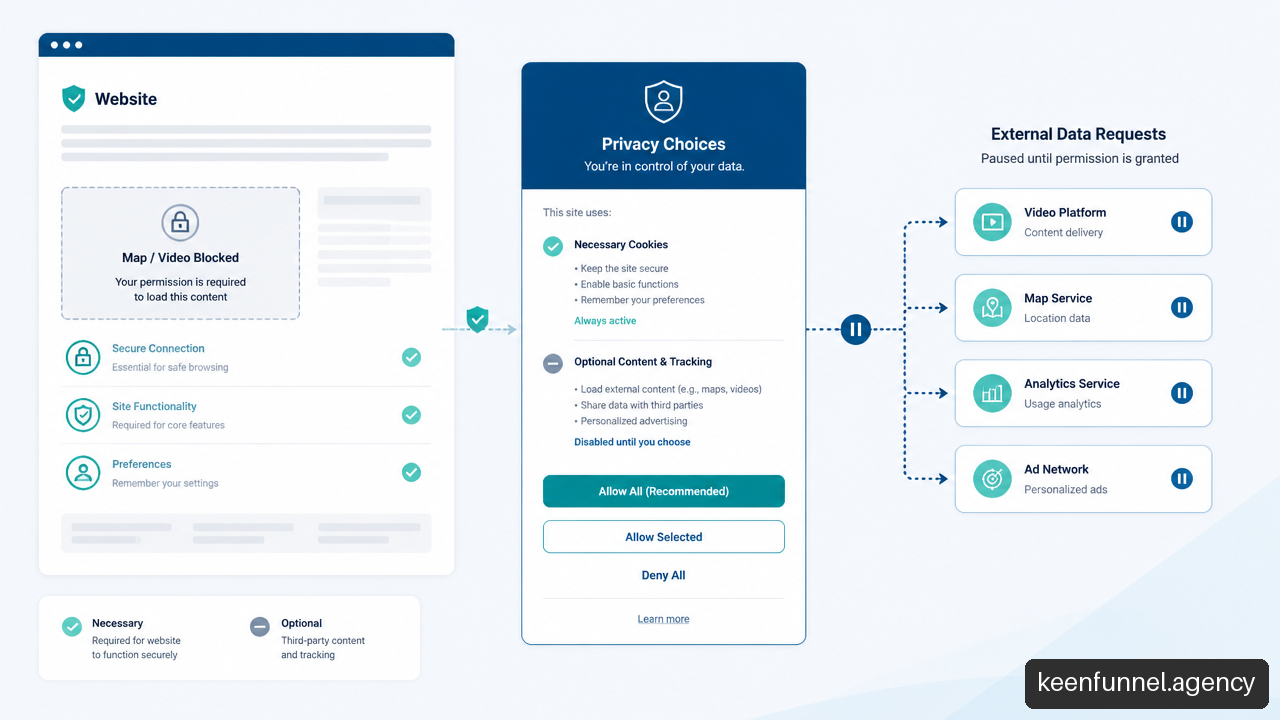
This approach also helps preserve a minimum service after refusal. A visitor should not automatically lose access to an entire site merely because they reject behavioral advertising or optional measurement. The business may need to decide whether a particular feature can operate without optional tracking, but that decision should be deliberate and documented.
Design Choices That Respect User Autonomy
Make The First Layer Clear And Balanced
The first layer of a cookie banner should state that the site uses necessary technologies and requests choices for optional purposes. It should provide a short explanation, a route to fuller information, and clear actions.
A balanced design commonly includes:
• Accept all for visitors who agree to all optional purposes
• Reject all for visitors who decline optional purposes
• Manage preferences for purpose level choices
The visual treatment should not pressure a person toward acceptance through hidden rejection controls, confusing wording, or repeated interruptions. Exact design expectations can vary by jurisdiction, but symmetry is a sensible risk control: refusal should not require more effort than acceptance.
Separate Choices By Purpose
Granularity makes consent usable. Instead of one vague “marketing” switch that authorizes every external platform, organize options around understandable purposes such as analytics, advertising, personalization, and social media or embedded content.
Your Europe explains that users should be able to choose cookie purposes separately and withdraw consent as easily as they gave it. The preference center should match the actual controls used in the tag manager and application code. If the interface offers an analytics refusal but the analytics script still runs in a limited tracking mode, explain that behavior precisely and assess whether it still requires consent.
Keep The Privacy Notice And Cookie Policy Connected, Not Bundled
A privacy notice covers broader processing: contact forms, accounts, customer support, payments, retention, and rights. A cookie policy focuses on browser or device technologies, their purposes, providers, and controls.
They can link to one another, but cookie consent should not be buried inside general terms or treated as automatic agreement to an unrelated privacy notice. Visitors need a focused decision at the point where optional tracking would otherwise begin.
Plan For Refusal Before Launching Campaigns
The hard question is not whether users can reject. It is what the business does after they reject.
For analytics, use a configuration that prevents the relevant analytics request until consent is granted, rather than collecting first and attempting to filter later. For advertising, prevent audience pixels, conversion tags, and retargeting identifiers from loading. For embedded content, show a privacy preserving placeholder. For personalization, provide a standard site experience where possible.
There is no reliable universal statistic for consent rates, rejection rates, or conversion effects. Results depend on jurisdiction, traffic source, audience, banner design, and measurement period. For instance, an ecommerce site with repeat buyers may see different behavior from a local service site with mostly first time visitors. Measure your own consent choices and business outcomes, but do not use a higher acceptance rate as the only measure of quality.
Test, Record, And Maintain Consent Operations
Test What The Browser Actually Does
A banner appearing on screen is not proof that consent blocking works. Test in a clean browser profile or private window, clear site data, and use browser developer tools to inspect network requests, cookies, local storage, session storage, and loaded scripts.
Run at least these paths:
Open the page with no saved choice and confirm which requests and storage actions occur.
Reject all optional purposes and confirm that advertising, analytics, social, and other optional tools remain blocked.
Accept one purpose only and verify that only its associated technologies activate.
Withdraw consent after acceptance and verify the suppression, deletion, or expiration workflow.
Repeat the test on pages with embedded video, maps, forms, checkout, and account functions.
Fair warning: some third party vendors use several domains and scripts. A scan can miss requests that occur after user interaction, and an apparently blocked pixel may still be initialized by a tag manager. Testing should inspect the underlying request behavior, not only the consent platform dashboard.
Make Withdrawal Operationally Effective
When a user withdraws consent, update the consent state immediately and stop future optional processing that depends on it. Also address identifiers already placed where feasible. This might mean deleting first party cookies, clearing local storage keys, disabling tags, telling supported vendors that consent changed, and ensuring a page reload does not restore the prior state.
The UK regulator’s guidance notes that people should receive information about withdrawal, including how already placed cookies can be removed. A visible path for withdrawing cookie consent and removing existing cookie controls is therefore more than a footer decoration.
Some third party identifiers may not be fully removable by your site once they are set in an external context. That limitation should lead to prevention: avoid setting them until the required choice exists. Where deletion is possible, automate it. Where it is not, document the vendor behavior, minimize future access, and seek legal and technical review.
Keep A Defensible Consent Audit Trail
Consent records should be reproducible. A useful record may include the pseudonymous consent identifier, timestamp, selected purposes, geographic rule set, banner or policy version, language, capture method, and whether the choice was later changed or withdrawn.
Do not collect more data for the log than necessary. The goal is to show what interface was presented and what choice was made, not to create another unnecessary tracking database.
Review triggers should be connected to operations, not calendar reminders alone:
• A new tag, plugin, campaign pixel, embedded tool, or vendor integration
• A redesigned template, checkout flow, or preference center
• A change in a provider’s data practices or domains
• A new region, product, or audience segment
• A scheduled rescan and test of high traffic site paths
This is where data privacy protection and cookie consent become part of digital governance. The system stays accurate when technology changes are visible to the people responsible for privacy, web operations, marketing, and development.
Frequently Asked Questions
What Is Cookie Consent, And How Is It Different From A Privacy Notice?
Cookie consent is the visitor’s choice about optional device storage, access, and related tracking. A privacy notice describes broader personal data practices. We need both because a notice alone does not stop an optional script from running.
Can Analytics Cookies Be Used Before A Visitor Accepts Them?
Often, no in European and UK contexts where the analytics setup requires consent. Do not assume an analytics label makes a cookie necessary. Review the specific configuration, purpose, data sharing, and applicable law. If consent is required, block the relevant tags and requests until it is granted.
Is Continuing To Browse Valid Cookie Consent?
Generally, it is not a reliable consent method under the cited European and UK guidance. Consent should result from a clear positive action, not silence, inactivity, or simply remaining on a page.
Do Cookies Need Consent If They Do Not Contain Personal Data?
They may. The relevant rule can concern storing or accessing information on a device, not just whether the cookie contains obvious personal details. Assess both device access rules and any later personal data processing.
Must Reject All Be As Easy To Find As Accept All?
A balanced interface is the safer approach. If accepting is one clear action while rejecting requires several screens or hidden links, the design may undermine the idea that consent is freely given. Keep refusal visible and understandable.
What Happens When A Visitor Withdraws Consent?
Future optional tracking should stop. The site should also remove or expire first party identifiers where possible, update vendor consent signals where supported, and prevent tags from restarting after a refresh. Necessary service cookies may remain when they are genuinely needed for the requested service.
Do Embedded Videos, Maps, And Chat Tools Need Separate Consent?
They can. These tools may contact external providers, set identifiers, or access device information. Treat each embed as a technology integration, classify its actual behavior, and use a placeholder or blocking method when it falls within an optional purpose.
Sources
UK Information Commissioner’s Office
UK Information Commissioner’s Office — Cookies and similar technologies
Your Europe
Your Europe — Data protection and online privacy
Your Europe — Online privacy: How to use cookies on your website
https://europa.eu/youreurope/business/growing/digitalising/online-privacy/index_en.htm
Data Protection Commission Of Ireland
Data Protection Commission of Ireland — Guidance note on cookies and other tracking technologies

